How to Find Your Own Color – Setting a Direction for Growth
Developer growth isn't about consistency: it's about direction and differentiation

Lately, I’ve been doing more mentoring — reviewing résumés, conducting mock interviews, and discussing growth strategies with developers who are relatively new to the profession. These conversations have been happening more and more frequently.
As these experiences accumulated, I started noticing patterns in the struggles people face. Today, I want to talk about those patterns.
These patterns show up not just in mentoring but in actual interviews as well, so in a way, this post might serve as interview advice too. Of course, developers with some years under their belt probably have an intuitive sense of these things already, so I think this post will be most helpful for those in the entry-level to two-year-experience range.
Going forward, I’ll continue framing the discussion around the emotions and situations of this group. Since writing “entry-level to two-year experience” every time would be tedious, I’ll just call this segment “juniors.”
Effort Without Direction
One of the most common concerns I hear from junior developers during mentoring is: “I can’t figure out the right direction for my growth.”
In my experience, people who join the Lubycon mentoring project or request mentoring through other platforms tend to be people who are self-motivated and working hard.
But because the direction of that effort isn’t clear, doubts like “Am I even on the right path…?” creep in, and they feel anxious despite putting in the work.
To ease that anxiety and find stability, it’s very easy to channel effort toward a direction that feels safe — meaning what lots of other people are doing. Common examples include daily commits (1 commit per day), writing TIL (Today I Learned) posts, and clone coding. In mentoring sessions and interviews, I see a remarkable number of junior developers engaging in these activities.
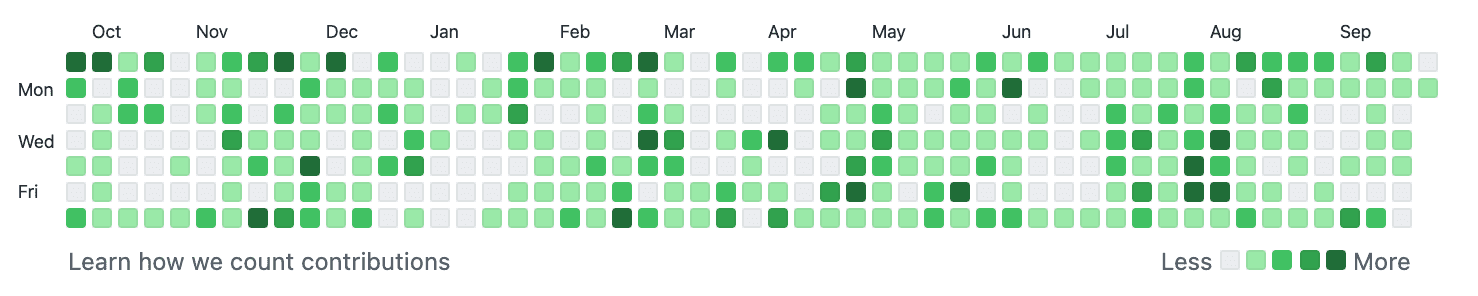 The contribution graph on a GitHub profile is data showing how active someone is in development-related activities.
Of course, doing something for your growth is a great attitude. But blindly jumping in because everyone else is doing it, or because a bootcamp told you it’s necessary for landing a job, may not be the best approach.
If you’re just starting out, simply committing every day or writing down what you learned on a blog might generate some growth. That’s because at this stage, rapidly getting comfortable with coding directly translates to growth.
But as you know, this phase passes fairly quickly. The more comfortable you get with coding, the more you encounter familiar things rather than new ones — and from that point on, simply coding alone makes it increasingly difficult to improve or learn something new.
Eventually, you start to feel that daily commits or TIL posts alone aren’t producing the same growth velocity they used to. And that’s when this question hits:
What should I study next to go further? What kind of effort should I be making now?
This is the state of putting in effort without a clear direction. You need to nail both the volume and the direction of your effort — only then can you get maximum return on the same amount of investment.
Thinking About the Cost of Effort
People tend to think of the effort they put into achieving something as a kind of cost — and it genuinely is. You’re investing your time and energy to create new value. That’s why we instinctively seek the most efficient form of effort — the direction where minimal input yields maximum return.
Unfortunately, there’s no predetermined shortcut in life. But you can gradually improve your effort’s efficiency by constantly asking yourself where the right direction might be. The method that maximizes efficiency differs from person to person, and the only way to find it is through your own reflection.
The problem is that many people can’t afford the mental space for this kind of reflection. Someone who experienced rapid growth through daily commits or TIL tends to think “I’m not growing because I’m not trying hard enough” — because of that past experience, or simply out of inertia.
But as I mentioned, misdirected effort leads to lower efficiency, and lower efficiency means the value of what your effort produces decreases.
For those who aren’t sure what “the value of your effort decreasing” means, I want to explain this from two perspectives: the market perspective and the perspective of continuous personal growth.
The Market Perspective
First, the place where the returns on your effort shine most brightly is the job market. And since the job market is literally a market, most of the principles we know about markets apply.
The principle I want to discuss is “inflation.” The basic definition of inflation is when something becomes so common in the market that its value drops. Usually we talk about the value of money dropping, but in the job market, think of it as the value of skills or credentials.
The most classic example of this inflation is education. In the 1970s, having a college degree commanded respect and gave you a significant advantage in job hunting. But by the 2020s, with college enrollment rates approaching 79%, simply having a bachelor’s degree no longer carries much weight.
In other words, the bachelor’s degree we spent 12 years earning — from elementary school through college entrance exams — has become something that most people in the job market possess. It’s become an ordinary commodity, and an ordinary commodity that everyone has is, by definition, one that has lost its value.
 As of 2021, the proportion of college graduates has grown compared to the past,
and having a degree no longer signals that you're an exceptional talent.
This is a fundamental market principle: when everyone has something, its value drops. And this principle applies to hiring as well. The job market is essentially a jungle of supply and demand where you have to compete against others to survive.
To survive in this jungle, you need to demonstrate that you’re better at the job than others, that you have higher growth potential — sending the message “invest in me and you won’t regret it” to companies, our consumers. That’s why people try so hard to graduate from good universities, earn certifications, and study abroad.
The bottom line: you need to be a differentiated person, a desirable product in the job market. This is no different for developers — the only difference is that the differentiation criteria focus on programming skills rather than credentials.
But the problem is that many people don’t think deeply about whether a particular asset will serve as a weapon in the job market — or whether it’s a weapon at all. They just think they need it because other people already have it. Much like our parents told us we absolutely must graduate college to make a living.
Sure, having it is probably better than not having it. But relative to the 12 years of effort you invested, a bachelor’s degree probably doesn’t guarantee proportional value. This is especially true in the IT industry, which values ability over credentials.
Similarly, activities like daily commits, TIL, and clone coding are already widely known. Bootcamps are even providing explicit guidance that these activities help with getting hired. When reviewing résumés, I can definitely feel that far more people are doing these activities than before.
In other words, these activities have become commodities that too many people possess. Simply having done them no longer makes a strong impression on an interviewer — just like a bachelor’s degree.
The Perspective of Continuous Personal Growth
Second, as I mentioned, activities like daily commits, TIL, and clone coding only generate meaningful growth during the very earliest stages of learning to code. There are limits to what you can achieve by simply being exposed to coding frequently.
Moreover, since these activities emphasize consistency, they can easily become mere habits. You end up just “doing them” without deeply considering what you’re learning from them or why you’re doing them in the first place.
The reasons people fall into this habit vary — inertia from having done it consistently, anxiety about falling behind if they stop — but regardless of the reason, continuing to pour effort in without clear direction can never produce sustained growth.
Worse, if you forget the original purpose of these activities and just repeat them mechanically, there’s a risk of becoming fixated on results over purpose — making meaningless commits to fill the daily quota, or even faking commit timestamps. This is actually a recurring theme in many people’s retrospectives on daily commits.
Ultimately, even if you have both the passion for growth and the energy to execute, if you can’t define a clear direction for yourself, your energy might end up invested in the wrong places.
So What Should I Do?
Alright, so what should you actually do? Obviously, I can’t provide a one-size-fits-all answer with perfectly clear action items in a single blog post.
But I can at least talk about things worth reflecting on — things you should sit down and think about seriously.
Beware of Fixating on the Act Itself
What does it mean to fixate on the act itself? Let me use the popular activity of daily commits as an example.
The act of “one commit per day” means nothing more and nothing less than making at least one commit each day. If you focus on the act itself, when someone asks “Why do you do daily commits?”, you can only answer with something like “Because it’s important to do something consistently.”
But as I discussed, once you’re past the very earliest stage of learning to code, mere consistency alone can’t produce sustained growth. If you’ve reached this stage, it’s time to ask yourself:
What is the essential value that daily commits create?
The answer will differ for each person, but I believe the essential value of daily commits is closer to “consistently working on my own development projects without letting go.”
In other words, the “commit” in “daily commit” doesn’t mean any random commit — it means commits toward building your own side project, contributing to open source, and so on.
As you know, a commit is ultimately part of the process of building something. But if you fixate on the act of committing itself, the goal of building something disappears into the distance, and only the “commit” remains.
When you focus solely on the act itself, you fail to capture the real benefits these activities offer and end up wasting energy.
Diligence Isn’t a Strong Weapon
A few years ago, I had a casual conversation with someone who had graduated from a bootcamp. I heard something interesting: at their bootcamp, students were told that writing TIL posts on their blogs was necessary for getting hired.
Of course, bootcamps are businesses, not charities, so they need to maximize results with minimal resources. Providing customized education for every individual is prohibitively expensive, which is why they end up creating standardized curricula and funneling people through them. (Most of the education industry works this way, honestly.)
So I asked:
“Why does writing TIL posts on your blog help with getting hired?”
I asked because I believe hiring involves an enormous number of variables — company size, current business conditions, the talent pool in the market, existing team members’ capacity — and I wasn’t convinced that any specific activity would universally help with employment.
The answer I got was: “Isn’t it data that shows diligence?”
Honestly, learning something new every single day and writing about it on a blog is no small feat. How can anyone possibly learn something new every single day?
Of course, a developer who just started coding might encounter new knowledge daily. But the more comfortable you get with coding, the less that happens. You can sustain this pattern by actively seeking out new knowledge, but it takes considerable effort.
And if the result of all that effort is merely to demonstrate “diligence” — well, personally, I don’t think that’s a good trade.
Because companies don’t hire people based on diligence alone.
Companies exist to generate profit. So naturally, when they hire, they want people who will earn back more than what’s invested in them. Diligence might be one criterion for evaluating such people, but it’s not a critical factor. If someone is a bit lazier than average but does great work, helps the team grow, and generates revenue — that’s fine.
On top of that, as I mentioned, TIL is already a widely recommended activity across multiple bootcamps, and many junior developers are doing it. Inflation has already arrived — simply having done it consistently is no longer that attractive in the job market.
So if you want TIL to be your weapon, you need something beyond mere consistency and diligence — something that differentiates you. For instance, diving deep into areas most people don’t study, or showing an extraordinary five-year streak of TIL posts without missing a single day.
To create these differentiating factors, you need to think about what value TIL truly provides.
TIL isn’t something you do to get hired. It’s an archive where you observe, learn, and record things to hand off to your future self. Yet many people write TIL posts as little more than rough, unorganized notes. And with notes that disorganized, revisiting them a year or two later for review won’t be easy.
This is a textbook example of using a good tool in a bad way. If you’ve been doing TIL or daily commits for the sake of employment, it’s time to reflect on what value you can genuinely extract from these activities and how that value can fuel your growth.
Nobody else will do this thinking for you, and no one will teach you the answer. It certainly won’t come quickly, but I recommend practicing — even just a little each day — the habit of questioning whether what you’re currently doing truly has meaning.
Build Intrinsic Motivation
The last thing I want to talk about is building intrinsic motivation. This connects to the earlier discussion about “activities done for the sake of getting hired or changing jobs” — because landing a job or making a career move is the quintessential example of external motivation.
Imagine you’ve been diligently doing daily commits or TIL to get hired.
The developer market currently has more demand than supply, and company founders are always asking “Know any good developers?” — so you’ll probably land a job eventually. (Everyone feels anxious during the process, but people tend to land jobs more easily than they expect.)
OK, so you’ve achieved your goal. Should you keep doing daily commits or TIL?
Maybe inertia carries you for a while. But once you start adapting to new people, new code, and a new environment at your job, it’s easy to stop — because you’re tired, or because adapting to the job takes priority over personal development.
The reason you stop might not actually matter that much. Because the moment you achieved your goal of getting hired, the very motivation to continue these labor-intensive, diligence-demanding activities simply vanished.
This is the fundamental problem with external motivation. Behavior driven by external motivation is easily abandoned the moment the source of that motivation disappears.
That’s why motivation should stem from intrinsic sources — like growth and genuine interest — rather than external conditions like employment or job changes.
Intrinsic motivation can also collapse due to internal factors like burnout, but at least it’s far more robust than motivation that evaporates the instant you hit your target.
Even if you’ve never deeply considered external versus intrinsic motivation, everyone instinctively knows which one is more robust.
If you were an interviewer and asked “Why do you write TIL?”, would you trust the person who says “To get hired” more, or the person who says “Because I enjoy developing” or “Because it helps me grow”?
The first answer naturally provokes the thought: “So they’ll stop once they’re hired?” And that reaction is exactly the risk that external motivation creates.
Of course, most people nod in agreement when I explain it with examples like this. But the truth is, we’re all very accustomed to lives driven by external motivation — and even I, the one writing this, find myself increasingly dependent on the external motivation of money as I get older. (Housing prices are absolutely maddening…)
Ultimately, what I want to say in this post isn’t that you should eliminate external motivation entirely. That’s impossible, and sometimes external motivation can create even greater momentum. But I do think it’s worth reflecting at least once on whether the motivation you’re currently depending on is sustainable going forward, and whether it truly helps your growth.
Closing thoughts
This might sound somewhat idealistic. After all, if you’re in an urgent, desperate situation where you need a job right now, it’s hard to find the headspace for this kind of reflection.
But everything I’ve discussed in this post will absolutely help your job search and career moves. Your real enemy is the anxiety whispering inside you: “Everyone else is working hard while I’m wasting time on these thoughts” or “I don’t have time to think — I just need to do something.”
Developers with relatively little experience often don’t have many weapons to showcase in the job market. So to put their best foot forward in interviews, they focus on fundamentals like algorithm problems and language comprehension, or on immediately actionable activities like daily commits.
Studying fundamentals is indeed essential — you could call it a developer’s basic literacy. And activities like daily commits or TIL can help you demonstrate qualities like diligence. But what matters is that interviewers ultimately aren’t looking for someone who’s merely knowledgeable in theory or just diligent — they’re looking for someone who can “get things done, whatever it takes.”
In other words, you need a strategy to stand out as a compelling talent in the job market. And crafting that strategy requires “effort with a clear direction.”
Before starting anything, try visualizing what you want from this effort and who you want to become. Establish your direction, then execute. If you keep practicing this, I believe you’ll eventually develop your own know-how and strategy to showcase what makes you special in the market.
This concludes my post: How to Find Your Own Color — Setting a Direction for Growth.
관련 포스팅 보러가기
How Developers Survive Through Learning
EssayWhy I Share My Toy Project Experience
Essay/Soft SkillsMigrating from Hexo to Gatsby
Programming/TutorialsCan I Really Say I Know Frontend?
EssayQuestion Driven Thinking — Learning by Asking Yourself Questions
Essay