Surviving as a Digital Nomad in Prague
What happens when a developer tries living abroad for a month in Europe

I arrived in Prague, Czech Republic on September 1st and am currently on vacation. Though calling it purely vacation feels inaccurate, since I signed a freelance contract with my former company, so I’m still coding here. I’m basically pretending to be a digital nomad.
Czech prices are cheap for Europe and internet is fast, so many developers from around the world apparently come here for digital nomading. Since some readers might want to try living in Prague for about a month like me someday, in this post I want to share my impressions of Prague after staying briefly and some tips.
I’m not a travel blogger and didn’t come to Prague for tourism but rather to try living here, so instead of talking about tourist spots like other travel blogs, I’ll mainly talk about daily life.
Brief Introduction to Prague
As you all probably know, Prague is the capital of the Czech Republic located in Central Europe. When German forces invaded during WWII, Czech didn’t fight the Nazis and surrendered early, so unlike other countries’ cities, many cultural heritage sites remain intact without destruction. That’s why Prague still retains much of its medieval European appearance rather than modern looks. The Old Town with Prague’s Old Square is designated a UNESCO World Heritage Site, showing how deep its history runs.
 The Charles Bridge area has nothing but old buildings
The currency isn’t the euro but koruna (Kč) - the exchange rate fluctuates around 50-53 won per koruna. I’m living here thinking roughly 200 koruna == 10,000 won. And since prices are cheap for Europe, living expenses come out about the same as Korea.
However, since it’s Europe there’s a 7-hour time difference from Korea, so people like me who brought work from Korea might need to wake up a bit early in the morning for communication. (For reference, Prague is UTC +02:00)
I naturally woke up early at first due to jet lag, but after about 3 days I’m reverting to my Korean life pattern and finding it harder to wake up early.
And the language is Czech, a Slavic language. Czech has some similarities to English but more differences, so without separate study it’s hard to understand or read. Since I wasn’t going to properly study Czech and didn’t have time, I just came without thinking. But since I came to Czech anyway, I wanted to try using Czech, so I memorized just a few simple sentences and am working hard combining them.
One tip: after first memorizing basic phrases like thank you (Děkuji) or hello (Dobrý den), definitely memorize I don't understand (Nerozumím) and Do you speak English? (Mluvíte anglicky?) next. This way you give locals a good first impression by using the local language and can also get help in English. Same anywhere you go - nobody looks badly on foreigners trying to use their language even if clumsily. (Got complimented by a passing grandpa at the mart for saying děkuji)
Now let me talk about several things I experienced while staying here these few days.
About MacBook Pro Retina Flight Restrictions
This is something I only learned the day before departure that flustered me a bit - not specific to Prague but I’ll mention it in case some don’t know.
Some MacBook Pro Retina models manufactured between 2015-2017 had several explosion accidents due to battery defects. So starting August 2019, when boarding planes operated by EU member airlines, you cannot transport MacBook Pros as checked baggage - you must bring them as carry-on. And you absolutely cannot turn them on during flight.
For non-EU countries, some airlines banned bringing MacBook Pros on planes entirely, so check carefully before boarding. In my case, since I came to the EU I could bring it, but since I don’t know how regulations might change when returning to Korea, I brought my safe 2009 MacBook Pro.
When I directly inquired with Czech Airlines, I received a reply that it’s fine as long as I don’t power it on during flight, but who knows how the situation might change later. Due to the nature of airline safety regulations directly tied to passenger lives, if just one or two more MacBook Pro battery explosion accidents occur, regulations could change without grace period.
Plus, if denied entry in Korea I could at least send it home by delivery, but if denied when returning from Czech it becomes difficult to handle, so I chose to bring the 2009 MacBook even though it’s a bit frustrating.
For details, see this related article.
Are Prices Cheap?
What I learned while researching before coming to Prague was that Czech prices are cheaper than expected. Of course, “cheap” means cheap for Europe - not that it’s incredibly cheap compared to Korea. But overall prices do feel cheaper than Korea.
However, foreign prices mean some specific items might be cheaper than Korea while others are more expensive, so after actually living here a few days, I didn’t feel that big a difference from Korea. Food ingredients are definitely cheaper than Korea, but electrical products like power strips were much more expensive than Korea. (Power strips cost over 10,000 won…)
Since I’m not good at cooking, I mainly buy food outside or buy instant food from marts - in this case, I spend about the same amount as Korea. Like buying a hamburger at McDonald’s costs about 5,000 won, buying a sandwich on the street costs about 3,000 won.
And before leaving, a friend said “water in Europe is super expensive” which scared me, but buying at Tesco, a 1.5L water bottle only costs about 600 won.
By the way, bottled water has blue packaging saying Neperlivá Voda. Ne means not, perlivá means sparkling, Voda means water. In other words, Neperlivá Voda means non-sparkling water. For those who don’t like carbonated water, take note.
What I definitely felt was cheaper than Korea was transportation costs - paying about 35,000 won for monthly transportation lets you use public transit unlimitedly. Since I spend nearly 70,000 won monthly just on transportation in Korea, transportation is definitely cheaper than Korea.
English Doesn’t Work as Well as Expected
Actually, I thought since Prague is a famous tourist destination, people would all speak English well. But outside areas where tourists mainly go - Prague Castle, Charles Bridge, Old Square - English doesn’t work as well as expected.
Of course, it’s not like Asian countries like Japan or China where they don’t understand at all, but if you speak too fast or use too complex vocabulary, they don’t understand well. And older people tend to speak less English than younger people.
And similar to Korea, going to large marts like Tesco, product names and section signs are all written only in Czech so you might get lost. On my first day I bought something labeled Mléko thinking it was milk, but it turned out to be yogurt milk. (I realized after pouring it on cereal)
If you’re staying long like me, studying basic words or phonics before coming to Czech would help. I trusted only English and came, and am now suffering quite a bit.
Getting Around on Public Transport
Prague’s public transport includes buses, trams, and subways. I personally think trams or subways are more convenient than buses. You can use public transport with tickets or a Lítačka card like Korea’s T-money, but Lítačka cards must be issued at city hall and require submitting passport photos so it’s bothersome. So I just bought a monthly ticket and am using it.
Tickets Operate on a Time System
Prague’s tickets aren’t distance-based like Korea but time-based. After buying a ticket, you put it in a weird machine called a punching machine and stamp the usage start time. In other words, if you buy a 90-minute ticket, from the stamped usage start time for 90 minutes you can freely transfer between trams, subways, whatever.
But if time passes while your body is still on public transport and you get caught by inspectors, you’re getting fined without exception. By the way, fare evasion fines must be paid in cash - 800Kč if paid on the spot, 1,500Kč if you need to withdraw cash from an ATM.
Looking at blog reviews, quite many people got fined for not punching tickets. But after actually riding trams and subways myself, I thought such mistakes are understandable.
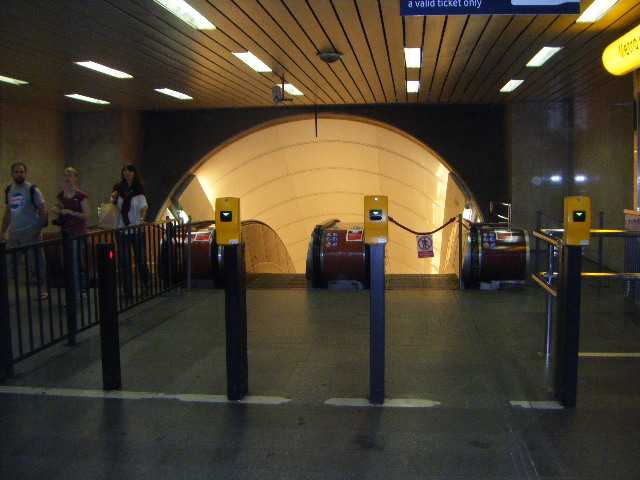 You just walk between those pillars
One thing that flustered me when first arriving in Prague was that there’s no mechanical ticket-checking system when using public transport. In Korea, turnstiles are blocked with partitions and only let you in after authentication, but here there’s nothing like that - it’s just wide open. Same with trams.
The yellow device in the photo above is the ticket punching machine I mentioned. When entering the subway, you must insert your ticket in that machine and stamp the ticket usage start time. For trams or buses, you just board when they come and stamp the start time in the punching machine inside the vehicle.
But honestly, since nothing like warning sounds goes off if you board without punching tickets like in Korea, it seems easy to forget if you zone out.
Ticket Types
Prague has 4 total ticket types with the following prices and usage times:
| Usage Time | Price |
|---|---|
| 30 minutes | 24Kč |
| 90 minutes | 32Kč |
| 1 day | 110Kč |
| 3 days | 310Kč |
In my case, I needed to buy a ticket to get from home to Prague Central Station where they sell monthly tickets - it was about 25 minutes by tram but I just bought the 90-minute one. Since I didn’t know what variables might occur midway, I defended myself like that - though buying exactly the right duration would have been fine.
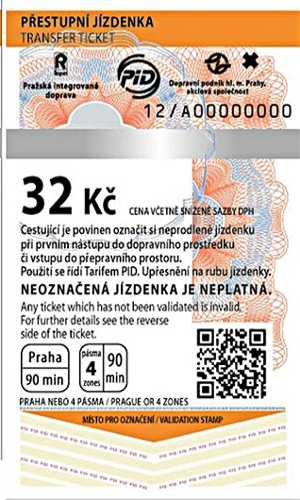 Insert the arrow-shaped part at the bottom into the punching machine to stamp the start time
Where to Buy Tickets?
So where can you buy tickets? Well, obviously near places where you can board public transport.
You can buy tickets at subway stations or shops near stops. For subway stations, when you enter there’s a ticket vending machine in a location where it feels like it should be, so just follow your heart, insert money and get a ticket. Any modern person can handle this difficulty so don’t worry.
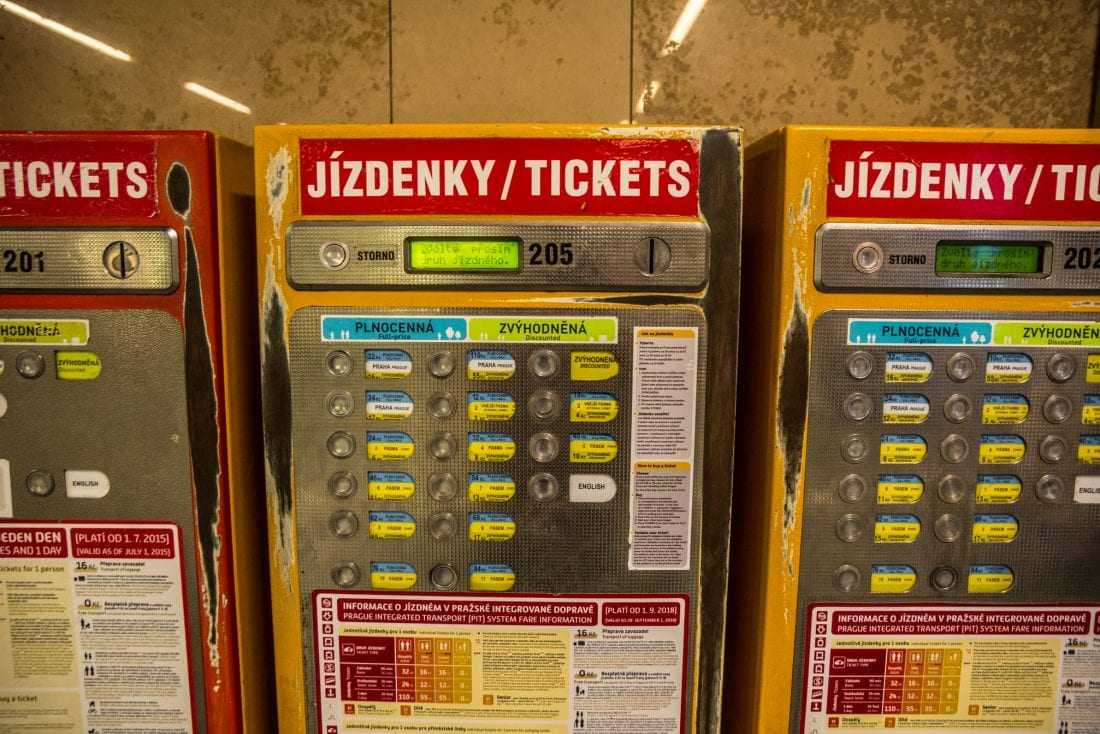 It blatantly says "Tickets" so no worries about not finding it
Buying tickets at shops near stops feels a bit harder because English isn’t well written on signs in this area. Most are written in Czech, and searching for shops one by one among European-style buildings that all look similar in an unfamiliar foreign land is harder than expected. So I recommend just buying at a nearby subway station when possible.
Buying Monthly Tickets
In most cases people stay in Prague for 2-3 days then leave for other cities or countries, so the tickets explained above suffice, but for people staying long like me, buying those tickets daily is quite bothersome.
People staying long like me usually buy monthly tickets or register “Lítačka cards,” but Lítačka requires going to city hall for issuance and submitting passport photos so it’s bothersome. So I just went to Prague Central Station and bought a monthly ticket.
According to information I found digging through blogs, any reasonably large station sells them, but since “reasonably” is ambiguous about how big a station means, I just went to Prague Central Station to also see the Old Town.
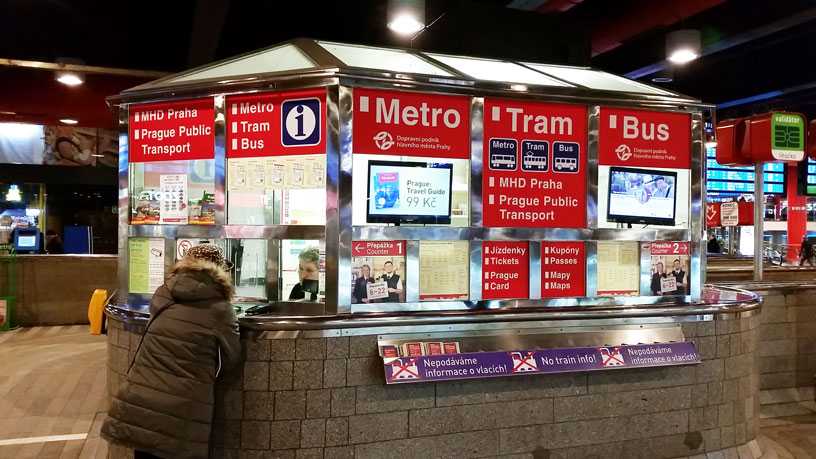 This information center-looking place sells monthly tickets
Monthly ticket price is 670Kč and unlike other tickets, no separate punching is needed. When inspectors check, just show it. When buying a monthly ticket, the seller asks when you’ll start using it - just say “I’m gonna use it right now” and they stamp the date and time.
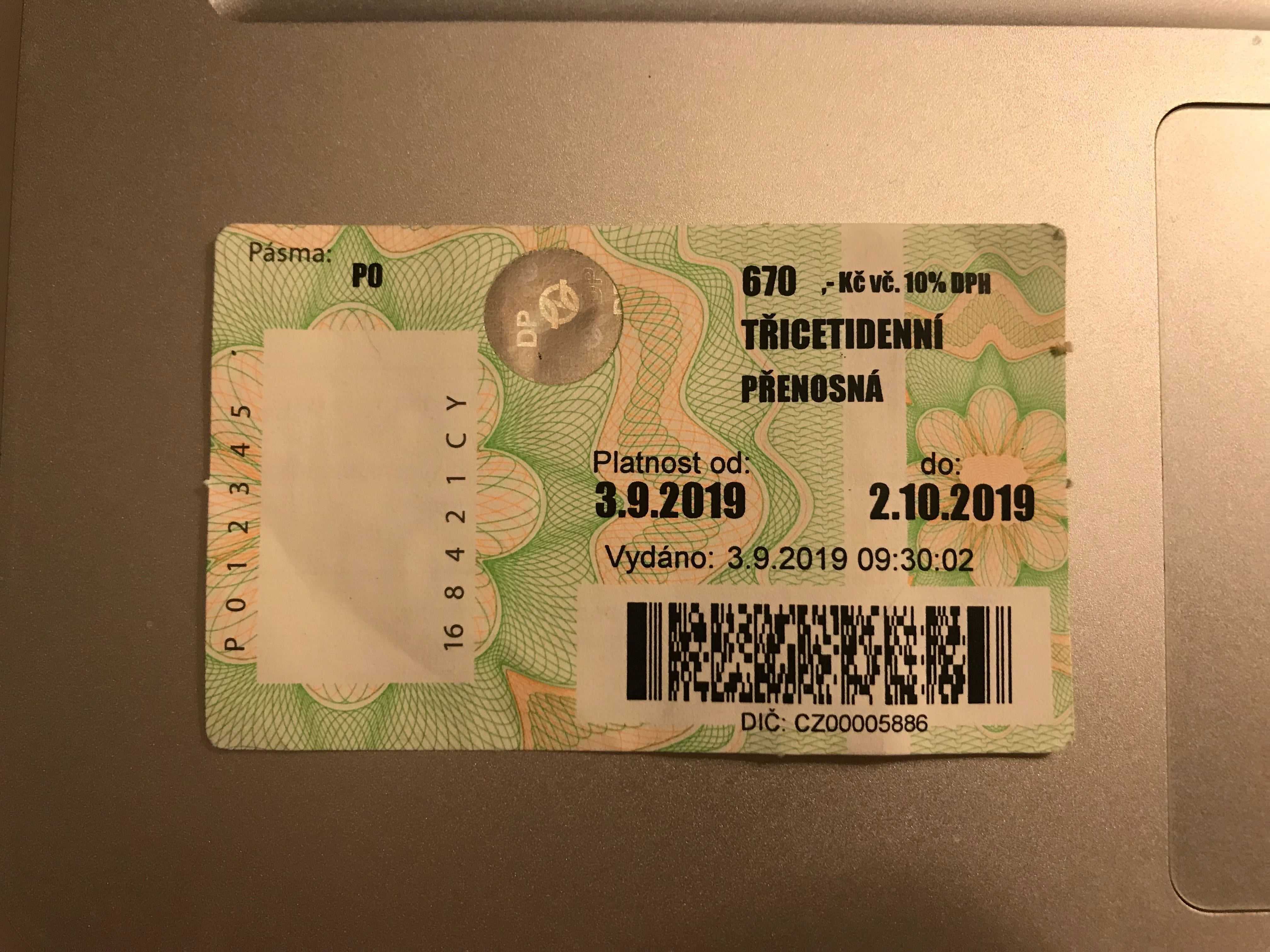 This is what monthly tickets look like
And besides public transport, there’s a Lime service like Korea’s Kickgoing where you can ride electric scooters. Usage is the same as Korea - install the app, register payment method, then scan the QR code on the scooter. This Lime company isn’t Czech but American, and apparently widely used in regions outside Asia.
Local Carrier SIM
When I usually travel short-term I just use domestic carrier roaming, but this time since I needed to stay a whole month, roaming would obviously result in fee bombs, so I had to buy a SIM.
Buying a SIM
You can buy SIMs at the airport or find phone shops in the city yourself. Just like Korea has giant carriers SKT, KT, LGT, Czech has 3 giant carriers called T-Mobile, Vodafone, and O2.
Among these I bought a SIM from the multinational carrier Vodafone that I’d used before in China and Hong Kong. Actually Vodafone has notorious rumors about poor communication coverage, but in my experience there were no particular problems in big cities like Shanghai or Hong Kong, so I thought Prague would be the same, and it actually works just fine.
 Vodafone stores show imposing presence visible from 300 meters away
Vodafone stores are painted bright red like Korea’s KT so they catch the eye easily anywhere. After finding a store, just enter and tell an idle employee “I’d like to buy prepaid sim card” and they handle everything. (Almost only Korea calls them yusim - other countries mostly say SIM card.)
The employee asked me about 3 things: how many days I’ll use it, whether I want data-only, and how many GB of data I want. Since I actually use an ultra-cheap 500MB plan in Korea, I didn’t know how much monthly data is appropriate. So while I was zoning out pondering, they immediately recommended 10GB, so I said fine, just give me 4GB.
The 4GB data SIM card price was 500Kč, roughly 26,000 won in Korean currency. Since I’ve never bought SIMs this way in Korea, I don’t know if it’s a fair price, but the price itself wasn’t that burdensome.
Looking at blogs later, I heard that if you obviously look foreign like Asians, some employees rapid-fire English and overcharge you, so rather than visiting stores thoughtlessly like me, you should think beforehand about how much data you need.
Registering the SIM
When buying SIMs from carriers, they handle activation all at once so you just need to activate it and it’s ready to use. No special documents are needed for activation - just receive the SIM and use it immediately.
 The back has the phone number and PIN number
The SIM case back shows information about the issued SIM - Telefonní číslo means the issued phone number and Poznámka means PIN number. The issued SIM is locked so you must enter this PIN number every time you turn the phone off and on. Vodafone just uses 1234, but other carriers have the PIN number revealed by scratching the card included with SIM purchase.
 By the way, many people here write 1 and 7 this way, so don't get confused
After buying the SIM and inserting it into your phone, it’s activated but not enabled. The carrier is detected and Vodafone CZ LTE shows in the status bar, but actual internet connection is blocked.
The SIM case has the activation method written, so just read carefully and follow… but that’s a bit ambiguous because this method is written in Czech. If you can use WiFi, just run it through a translator, but if you can’t use WiFi, just ask carrier employees for help. I naturally assumed it would be in English and boldly just left, then grabbed a passerby in the middle of the street asking for help.
Anyway, Vodafone’s SIM activation method is as follows:
- When the SIM activates, Vodafone sends a formal activation congratulations message with a password.
- Call
*77. Don’t panic if Czech comes out. Pressing*lets you proceed in English.- Enter the password confirmed in step 1.
- They explain about fees and taxes - you can just hang up.
The problem is this doesn’t activate immediately but takes some time. The carrier employee said 10 minutes would do, but it took me a bit over 3 hours. And when the SIM activates, the sent message also includes a link to check remaining data and services in use, so don’t delete the message.
If this still doesn’t work, check the APN settings once. In my case, I once set the APN to a local carrier when I went to Japan before, and when returning to Korea and resetting, the APN was set to lte.sktelecom.com. If another carrier’s APN is hard-coded like this, naturally internet won’t work so delete that value.
Pay in Local Currency When Using Cards
I’m currently going around Prague trusting basically only my Kakao check card. Those who’ve frequently paid with cards abroad know, but when paying you can choose local currency payment or won payment.
Choosing won payment means the payment amount is converted and charged at that day’s exchange rate and tells us how much was charged in won. So there’s an advantage of seeing at a glance how much I spent.
But the problem is that besides overseas payment fees, a DCC fee is additionally attached so fees double. Plus, the exchange rate applied when changing local currency to won favors merchants and banks over customers, so it’s best to avoid when possible.
For Kakao check cards, there’s a setting in the Kakao Bank app to simply block overseas won payment, so turning on that option prevents double fee charges from won payment.
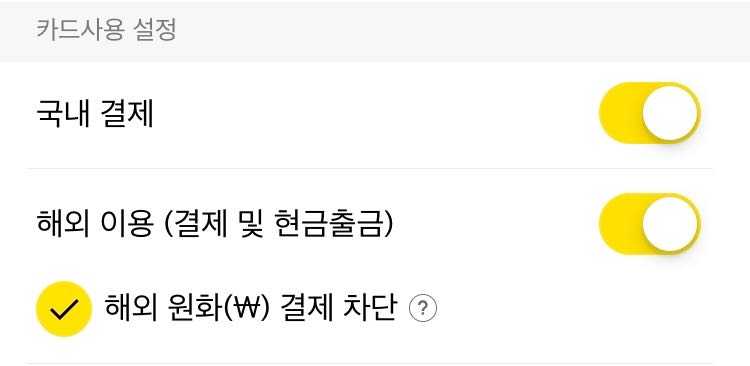 Can easily set in Card > My Card > Card Management
But the real problem is most stores don’t have employees receive cards and process payments - customers directly insert cards into payment machines themselves. In Korea too, places like Starbucks sometimes have customers directly insert cards into payment machines, but here most use that method.
When employees process payment, just saying “I’ll pay in local currency” gets understood and handled, but when I directly insert my card into the payment machine, I inevitably panic since I’ve never used this machine and it comes out in Czech.
But don’t panic. After inserting the card in the machine, a screen appears confirming the amount - look carefully and it asks Select currency? with CZK and KRW below. Pressing the red cancel button charges in Czech local currency koruna, pressing the green confirm button charges in won. At first I didn’t look at the screen carefully and just pressed the green button thinking it was just final amount confirmation.
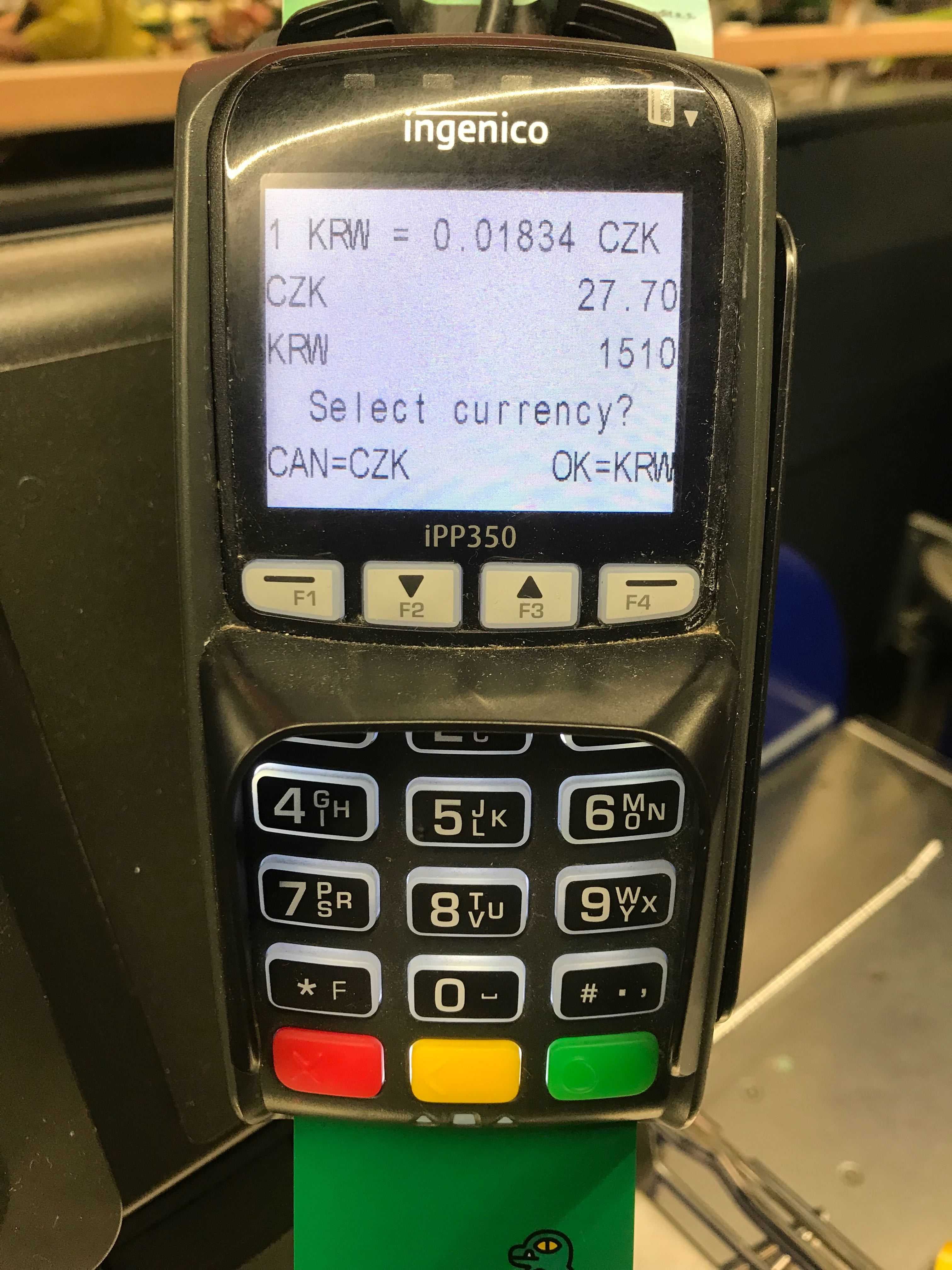 You can choose which currency to pay in
And while most use the same machine as the photo above, places like McDonald’s using different payment machines sometimes require entering check card PIN for payment. Try entering the 4-digit PIN and if it doesn’t work, add 00 to make it 6 digits and payment works. (Just struggled with this at McDonald’s)
Looking into Coworking Spaces
I signed a freelance contract with my former company before coming to Prague and this contract started September 2nd, so I need to work while in Prague. Fortunately WiFi works great at home so I could work from home, but since I came abroad anyway, I’m working at coworking spaces to talk with developers from other countries.
Since Prague has quite many people coming for digital nomading from other countries, there are quite a few coworking spaces. And most coworking spaces provide day passes for single-day use, so I recommend visiting several places to scout out good ones.
I picked out several Prague coworking spaces on Coworker.com and visit whenever I have time. Generally daily fees are about 200Kč to 300Kč. I think compared to cafes, coworking spaces are good because you get opportunities to network with developers from other countries and can freely use water, coffee, and bathrooms. (In Europe you pay for bathrooms. Plus they only accept coins.)
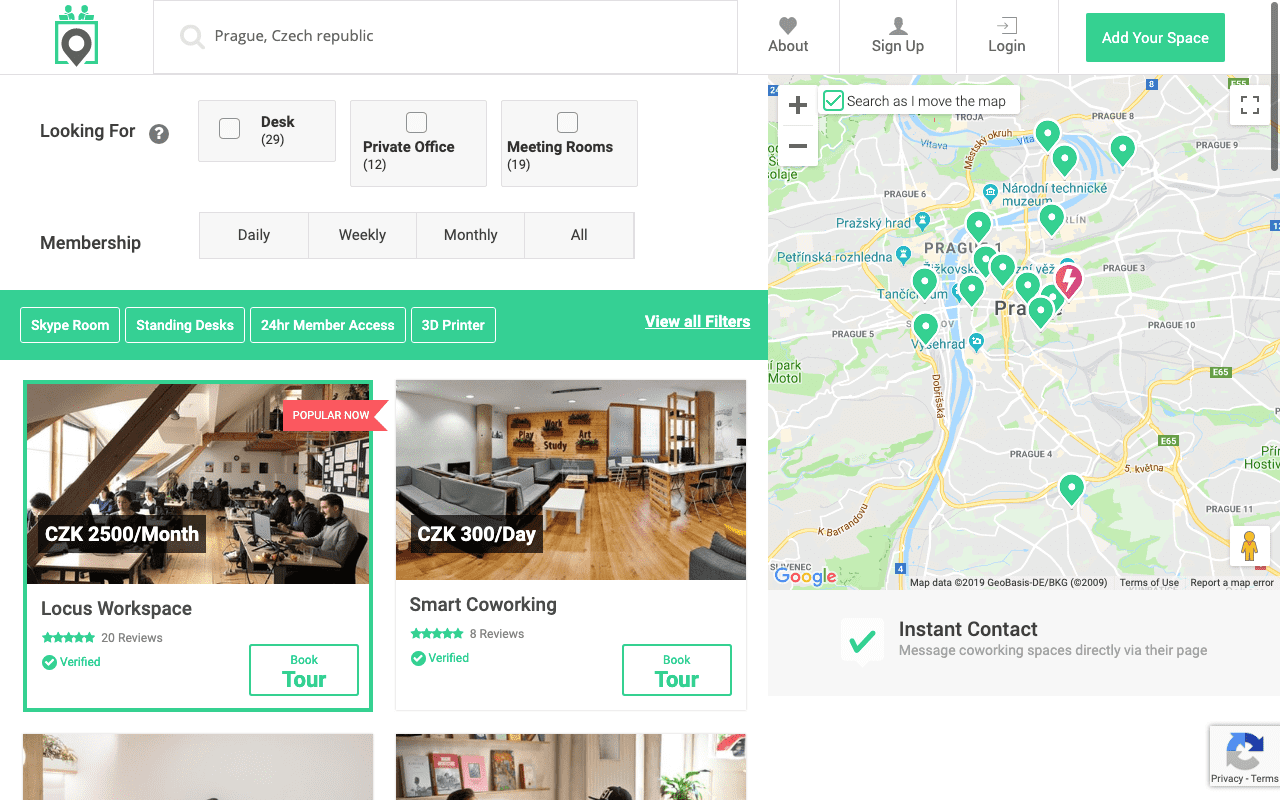 Searching Prague on Coworker shows many coworking spaces
And at cafes, leaving stuff on tables when stepping away for bathrooms or smoking has high loss risk, but coworking spaces are safe. At first I couldn’t trust even coworking spaces so I packed everything and went to the bathroom, but staff said I could just leave it and I felt awkward.
If you’re planning to stay near Andêl station in Prague 5 district, I recommend Impact Hub D10. The counter staff spoke English extremely well and was friendly, and the interior space design was nice. But the day pass price is 390Kč, a bit more expensive than other coworking spaces.
 Impact Hub D10's central hall
But surprisingly there weren’t as many developers as I expected. About 5-6 including me? Maybe it was just that time, but compared to Korean coworking spaces I was surprised there weren’t many developers. Maybe that’s why other developers showed interest and talked to me first when I was coding.
Some British developer asked me “where are you from,” “what kind of developer are you,” “what are you making now,” so I said the current work is migrating a legacy application to a newly made application, and they showed interest in the legacy structure and asked about it.
But this guy… after listening to the legacy explanation, he made a serious face, shouted “Good luck, mate” and went to get coffee. (I expected some tip or something)
Since I’m staying in Prague 5 district, I only went to the D10 space, but there’s also a K10 space in Prague 2 district. But here the day pass price is 500Kč. Actually I haven’t been there so I don’t know why it’s so expensive, but looking at photos the interior seems more luxurious. Anyway, since Impact Hub is a global company, it might be a good choice if you want verified facilities.
Wrapping Up
Actually I’ve only been in Prague about 5 days so I don’t know every nook and cranny of Prague. Plus since tourism isn’t the purpose, I haven’t toured many tourist spots and am just walking around for strolls, so I don’t know much about tourist sites either. Actually when I’m at cafes coding like in Korea, I sometimes forget this is Prague.
However, staying for the long time of a month, I can feel this city’s unique daily life with more leisure than typical travel, which is nice. Just going outside and walking around the neighborhood shows completely different, exotic scenery from Korea, which is fascinating, and talking with developers from other countries at coworking spaces is fun too. (Actually developers as a species feel pretty similar in any country)
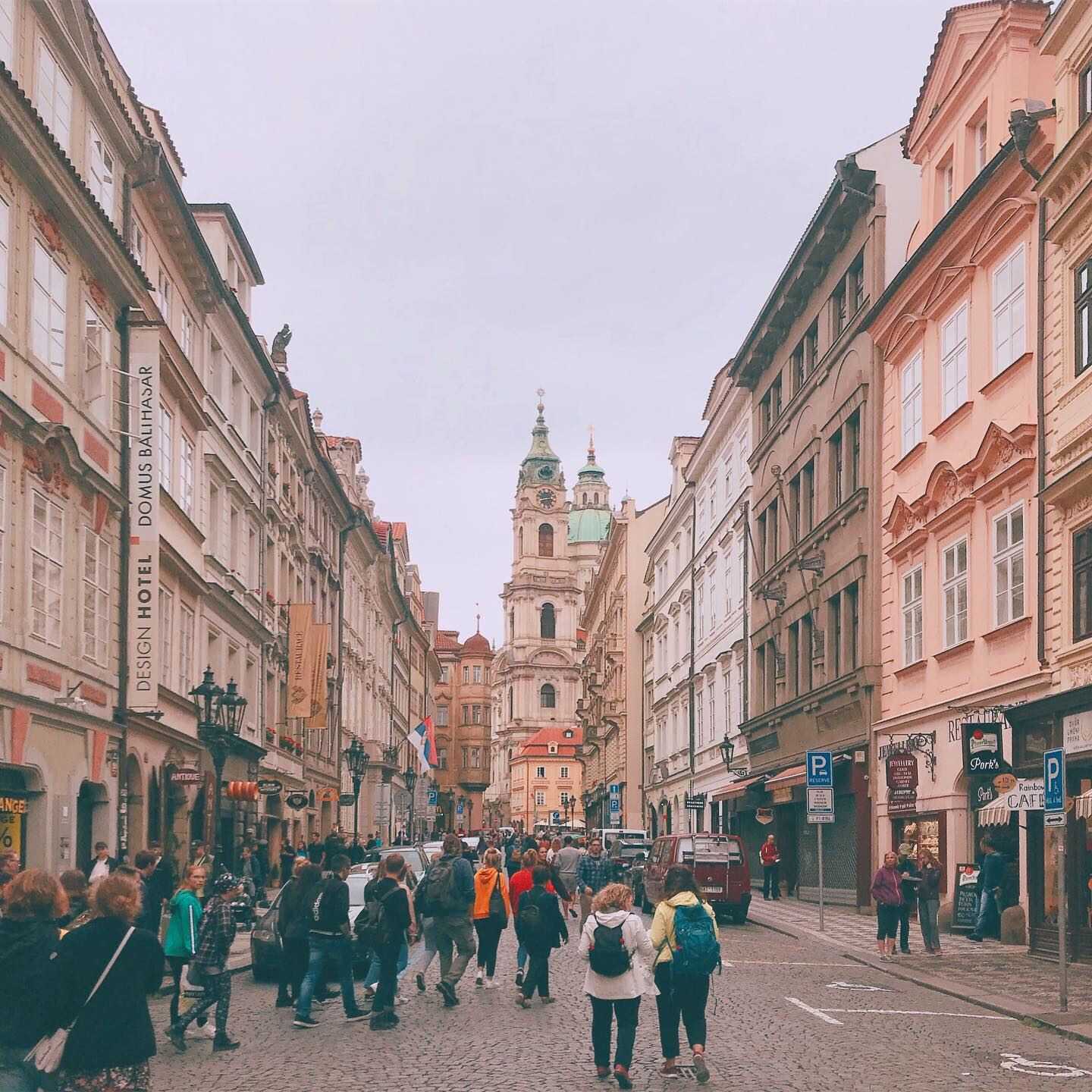 This area definitely has strong European vibes
Anyway, when I return to Korea next month I’ll have to go to interviews and wrap up freelance work so I’ll be busy, so while I’m here I’m trying to take maximum leisure. Since it’s September the weather is nice so it’s good to read books in the park.
Actually before departing I had many worries, but after actually coming here, this is also ultimately a place where people live so even if problems arise I can somehow solve them. And I worried because Czech people are supposedly blunt, but they just have expressionless faces - their actions are all kind. (Tsundere)
Living for a month in a foreign country with different culture and language isn’t easy, but for me whose only overseas experience is travel or business trips, this experience will become an extremely precious memory.
That’s all for this post on surviving as a digital nomad in Prague.
관련 포스팅 보러가기
How to Find Your Own Color – Setting a Direction for Growth
EssayWhy I Share My Toy Project Experience
Essay/Soft SkillsMigrating from Hexo to Gatsby
Programming/TutorialsCan I Really Say I Know Frontend?
EssayQuestion Driven Thinking — Learning by Asking Yourself Questions
Essay