Asset Management Is a State Management Problem
Why I stay calm even with aggressive investments

In this post, I want to step away from technical topics and talk about something closer to everyday life: asset management.
First, let me be clear: I’m not wealthy, and I don’t have some secret formula for making a fortune overnight. What I do have is years of thinking about how an ordinary salaried worker can steadily grow their assets over time.
If you’ve already made serious money through business or investing, this might sound obvious. But for someone like me, managing assets from a fairly average starting point, I think there’s plenty here to relate to. So I’d like to share the framework I’ve built for myself.
Without Knowing Your Current State, No Judgment Is Possible
One of the things I consider most important in asset management is knowing where I currently stand. To do this, I’ve been consistently recording my asset data.
Nobody gets asset management right from the start. Most of us go through trial and error, gradually building our own criteria along the way. But if you don’t even know your current state, it’s impossible to judge whether you’re on the right track.
I’ve been taking a monthly asset snapshot since 2018, when I started working as a developer. Looking back, this accumulated data now shows the trajectory of my assets at a glance — but at the time, it was often more confusing than clarifying. Some months my assets grew; other months they shrank more than expected.
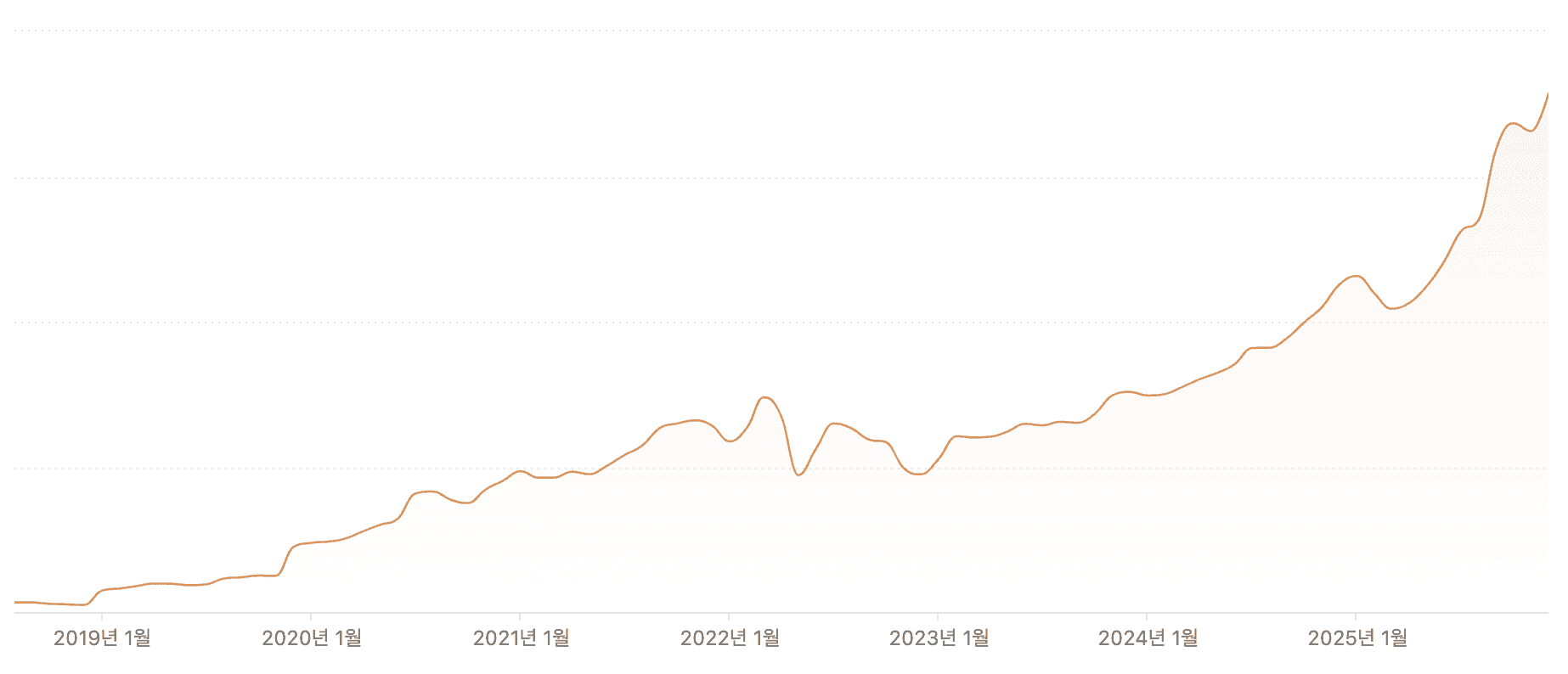
With this data accumulated over time, I can see at a glance how my assets reacted to market events, what my monthly asset growth rate looks like, and how much my assets have grown compared to five years ago.
The thought that came up most often while keeping records was: “Am I heading in the right direction?” What mattered wasn’t whether my assets went up or down in a given month, but whether I managed to stick to my predetermined criteria without being swayed by emotion.
The numbers I see today are just outcomes. The real value of this data, for me, lies in being able to verify that my current choices remain consistent with my past judgments — even amid uncertainty. Without these records, I would very likely have lost my way somewhere along the line.
That’s why I don’t use asset data as a tool for predicting the future. I use it only to confirm where I stand right now, and to check that my decision-making criteria haven’t drifted.
Right Abstraction Matters More Than Precise Numbers
It’s widely known that data matters in finance and asset management. The most common starting point is an expense tracker — recording income and expenses to understand your cash flow is certainly meaningful.
The problem is that this tool doesn’t tend to last very long. When you try to classify dozens or hundreds of transactions each month and get every number exactly right, it starts to feel like a burden. If the numbers don’t balance perfectly, it nags at you, and once you fall behind on recording, you end up abandoning it altogether. I went through this cycle several times before giving up on keeping a detailed expense tracker.
But if you think about it, the problem can be framed differently.
 Does it really need to be exact...?
The core issue wasn’t that I stopped recording. It was that I took the premise of precision for granted. We’re not doing corporate accounting or filing tax returns with our personal finances, so is data accurate down to the last dollar really essential?
What matters more in personal asset management isn’t precise numbers. It’s whether you can simplify the complex reality of finance into something you can actually judge. In this sense, asset management is pretty similar to how developers handle complex systems.
When we write programs, we don’t manipulate memory addresses directly. We don’t try to solve everything with bit-level operations. Instead, we use abstractions like variables, types, and interfaces. We sacrifice some fine-grained control in exchange for the ability to understand the overall structure and make better decisions.
I think the same thing happens in asset management. If you try to decompose and categorize every expense precisely, your judgment slows down and emotions have more room to creep in. Conversely, if you summarize the structure into a few key metrics, you can much more quickly assess whether your current state is risky, sustainable, or safe enough for aggressive moves.
In the end, abstraction matters in asset management not because it’s less work, but because it simplifies your decision-making criteria. What matters more than where you spent an extra $10 is whether you’re in a financially safe state, whether your cash flow is structurally sustainable, and what options you have for reaching your goals.
I believe asset management is the process of establishing criteria that won’t waver even in uncertain situations. And those criteria are built on well-designed abstractions, not precise data.
Assets Can Be Summarized as Flow and State
I mentioned earlier that asset management is a problem of abstraction, not precision. So what information do you actually need to abstract personal assets into something you can make judgments about?
It turns out you don’t need much. At a high level, two things are sufficient: data on asset flow and data on current state.
This is similar to the cash flow statement and balance sheet found in corporate financial statements. With just these two reports, you can quickly understand how a company earned and spent its money, and what its current financial position looks like.
Personal asset management isn’t fundamentally different. You don’t need corporate-level accounting, but you should at least know how money flows in and out, and how your assets are currently structured.
Asset flow can be tracked through cash flow data — how much you earned this month, how much you spent, and what’s left over. This data determines the speed and direction of your asset management. If the flow isn’t healthy, your assets will eventually stagnate or shrink.
Asset state, on the other hand, is tracked through snapshot data: how much immediately available cash you have, what forms your assets are tied up in, and how much debt you carry. This data reveals the range of risk you can currently absorb.
Neither dataset needs to be perfectly accurate. What personal asset management requires isn’t numerical precision but a sense of structure. It matters more to know your rough income-to-expense ratio than to know your exact spending this month. Likewise, knowing the ratio of liquid to illiquid assets matters more than having your net worth accurate to the last ten dollars.
When you separate flow and state like this, asset management gets simpler. Is the flow stable? Does the state carry excessive risk? Being able to answer just these two questions enables most important financial decisions.
Rather than trying to look at more data, I’ve focused on consistently checking these two pieces of information. As a result, even when market conditions changed or my assets grew in size, my decision-making criteria remained largely stable.
Now I’d like to go into more detail about how I approach each of these. Let’s start with cash flow.
Cash Flow: Look at Ratios, Not Detailed Logs
Understanding asset flow ultimately comes down to checking how much you earned in a month and how much you kept. When people think of managing cash flow, they usually think of an expense tracker, but I don’t think detailed expense tracking is necessarily the right answer.
The purpose of an expense tracker isn’t really to record exactly where every dollar went — it’s to understand the structure of your income and spending. But in many cases, the means and the end get reversed. Once the recording itself becomes a burden, understanding your flow becomes impossible, let alone maintaining the habit.
So when managing cash flow, I use much simpler categories than itemized expenses:
| Major Category | Subcategory | Category |
|---|---|---|
| Income | Employment | Salary |
| Employment | Business | |
| Debt | Loans | |
| Investment | Dividends | |
| Sale proceeds | ||
| Interest | ||
| Expenses | Consumption | Personal spending |
| Fixed costs | Insurance | |
| Phone/internet | ||
| Utilities | ||
| Housing | Rent | |
| Maintenance fees |
There’s no single right answer for these categories. What matters isn’t copying someone else’s structure, but understanding why you chose to split things the way you did.
In my case, I separate employment income from investment income, and I break out fixed costs and housing from general spending. I wanted to see what proportion of my income is passive, and how much of my earnings go to housing. If that information isn’t useful to you, bundling all spending into one category works perfectly fine.
Even with this rough structure, it’s more than enough to see how much I earned in a month and how much I kept.
Organizing cash flow this way already reveals a lot, but the single most important metric in my view is the profit margin — roughly what percentage of monthly income I’m keeping.
This one number contains more information than you’d think. It intuitively shows whether income is growing, whether spending is excessive, or whether your lifestyle is outpacing your asset growth. You might not know where an extra $50 went, but you definitely know whether you kept 30% or 50% of your income this month.
For reference, as of 2025, the average consumption-to-income ratio for South Korean households is around 67% — meaning on average, people keep about a third of their income. Including loan principal and interest payments, the effective spending ratio is even higher. This isn’t an absolute standard, but rather a reference point for gauging where your cash flow stands relative to the social average.
If you use the average as a benchmark, keeping more than 30% of your income suggests you’re probably not in a structurally strained position. Of course, this varies by individual circumstances. What matters isn’t the exact percentage but continuously monitoring which direction your cash flow is moving.
I’m not saying that detailed expense analysis, like traditional expense tracking, is meaningless. Knowing where money is leaking can certainly help reduce spending. But I think it’s better to focus first on improving income structure rather than cutting expenses.
There’s a hard floor on how much you can cut. You can’t skip rent or eliminate living expenses entirely. No matter how frugal you are, there’s a minimum you’ll hit.
Income, on the other hand, can expand depending on structure. Salary raises, job changes, investment returns, dividends, side income. Each new channel takes time to build, but the ceiling is open. This difference isn’t just about the dollar amount; it’s about whether you have a strategy that’s sustainable over the long term.
That’s why when I look at cash flow, I focus on “how much did I keep” rather than “how much did I spend.” If the profit margin stays stable, room to grow assets naturally follows. And that room becomes the foundation for the next set of choices — how to allocate assets and what level of risk to take on.
Now that I’ve covered the “velocity” of cash flow, it’s time to look at the “state” — how assets are currently structured.
Asset State: Look at Structure, Not Size
If cash flow data shows the “flow” of income and expenses, an asset snapshot shows the current state. I regularly check how much immediately available cash I have and what forms my assets are tied up in. The exact figures for each asset don’t need to be precise — in my case, I consider a margin of error around $1,000 to be perfectly acceptable.
When constructing an asset snapshot, the same principle applies as with cash flow: what matters is structure, not precision. Here are roughly the categories I use:
| Major Category | Subcategory | Category |
|---|---|---|
| Assets | Cash | KRW |
| USD | ||
| Savings deposits | ||
| Housing subscription savings (Jucheongnyak) | ||
| Investments | Domestic stocks | |
| Foreign stocks | ||
| Real estate | ||
| Pension | ||
| Other | Vehicle | |
| Jeonse deposit | ||
| Liabilities | Short-term | Credit card |
| Long-term | Loans |
Again, there’s no single right answer. What matters is what questions this breakdown helps you answer. In my case, what I care about most isn’t total asset value — it’s the ratio of liquid assets to illiquid ones.
Even with the same total assets, the situation changes entirely depending on what form those assets take. If you hold a sufficient proportion of assets that can be quickly converted to cash, like savings or stocks, you retain options even when markets shake. Conversely, if most of your assets are locked up in forms like housing deposits or real estate that can’t be easily moved, even small volatility becomes immediate pressure. This is the benefit that liquidity provides.
To me, liquidity is closer to optionality than “how quickly can I sell.” With sufficient liquidity, you can afford to wait, and when circumstances change, you can choose to act on opportunities. Without it, even the choice to do nothing becomes difficult — because market volatility transfers directly into psychological pressure.
From this perspective, an asset snapshot is less about checking how much you own and more about gauging how much risk you can currently handle. That’s why when I look at my snapshot, I check whether the overall structure is putting undue strain on me before looking at any individual asset’s price.
So what metrics are useful when reviewing asset state? One reference metric I use is monthly asset growth rate. The key point is that I don’t treat this as a target. Rather than setting a goal like “grow assets by X% each month,” I use it as a secondary indicator to check whether the current trajectory is holding.
According to a Ministry of Economy and Finance report released last year, the average household asset growth rate for 2025 was approximately 4.9% — which works out to roughly 0.4% per month. Of course, assets have far more variability than income, and individual differences are large, so this average doesn’t mean much on its own. But having this number in mind helps you gauge whether your assets are significantly deviating from the overall trend.
The important thing is that this number isn’t the answer. A high monthly growth rate doesn’t necessarily mean things are going well, and a low one doesn’t mean your choices are wrong. What matters is whether your assets are maintaining a consistent long-term direction, and whether you’re accumulating risks you can’t handle along the way.
I believe direction matters far more than speed in asset growth. Achieving large returns in a short period matters less than maintaining a consistent direction with modest monthly changes — because that’s what lasts. So at the end of each month, I review my cash flow and asset snapshot together, checking what changed from the previous month and whether any asset is becoming a structural burden.
This process naturally leads to the next question: how much volatility can the current asset structure withstand? To answer this, I consider the proportion of safe assets alongside my investment strategy.
Investing Is a Choice That Changes Your State, Not Your Returns
Once you’ve been managing assets for a while, you inevitably arrive at the question of how to think about investing. It’s less about chasing higher returns and more about wondering whether the current asset structure can maintain its direction over time.
Investing is most often discussed in terms of returns — which stock will go up, when to buy and sell, which strategy yields the highest gain. I won’t say these discussions are entirely unimportant. But from my experience, they only matter when one prerequisite is in place:
Can you handle the volatility?
Investing inherently involves volatility. Prices can rise, or they can move against your expectations. The problem is that the same volatility doesn’t hit everyone the same way. A 10% drop might be just a number for one person, but for another it’s pressure that shakes their judgment.
What creates this difference isn’t investment knowledge or stock-picking ability — it’s asset structure and state. Specifically, whether you have regular, predictable cash flow, whether your assets are excessively concentrated in one area, and whether your psychological state can withstand the volatility. These factors have a far greater impact.
That’s why when I talk about investing, I think the first question should be “In what state am I making this choice?” rather than “How much can I make?” How much risk can you take on, and will that risk translate into real-life financial pressure or emotional decision-making?
From this perspective, investing and risk management aren’t separate topics. How you handle risk changes the very nature of the investment itself. The same strategy can produce entirely different outcomes depending on the structure it’s built on.
Let me now discuss how to think about risk management, and the roles that earned income and safe assets play in absorbing that risk.
Risk Management Is Designing Protection for Your Judgment
The fundamental skill of investing is actually very simple: buy low, sell high. Almost no one would argue with that statement. The problem is that following this simple principle in practice is far harder than it sounds.
It’s not hard because the math is complex or because information is lacking. In most cases, the cause of failure is emotion. When prices rise, you feel they’ll keep rising; when they fall, you feel they’ll keep falling. Your mind might judge that now is cheap, but your hand won’t move toward the buy button.
This emotional pull is especially strong during downturns. More than the drop itself, it’s the anxiety of “Did I make the wrong call?” that surfaces first. That anxiety gradually blurs your criteria. The hypotheses and conditions you originally set get pushed to the back of your mind, and the immediate price movement starts dictating every decision.
This is where most people feel that investing is hard. But I see this as less of a technique problem and more of a state problem. The question is whether you’re in a state where you can emotionally withstand this volatility.
Risk management is closer to managing this state. The way I see it, risk management isn’t a technique for avoiding losses — it’s the process of designing an environment where emotions don’t override judgment. It’s about securing enough breathing room that you don’t need to make decisions just because prices are moving, enough time to consider your next move even when you might have been wrong, and enough distance to test the criteria you originally set.
Only when this environment is in place can the fundamentals of investing actually work. When prices drop, you can revisit your reasoning instead of panicking. When prices rise, you can reexamine your thesis instead of getting excited. The simple principle of buying low and selling high only has meaning on top of a structure that keeps emotions in check.
That’s why when talking about investing, I always ask “Am I in a state to handle this choice?” before “How much can I make?” The same strategy can yield entirely different results depending on what asset structure, cash flow, and psychological headroom it’s executed on.
Seen this way, the essence of investing isn’t predicting prices. It’s designing an environment where emotions don’t interfere. The elements that support this environment are more mundane than you’d expect.
Let me now talk about one of the key components of this risk management environment: earned income — why it matters for investing, and why it’s so often undervalued.
Earned Income Is the Most Stable Hedging Layer
“A salary is meaningless.” “You can’t get rich on earned income.” These statements are repeated so often in investment circles that they’ve become common wisdom.
They spread especially easily during bull markets. When asset prices are rising fast, a fixed monthly paycheck looks slow and frustrating. Placed side by side with investment returns, it does look modest by comparison. But this statement is only partially true from a returns perspective — from a risk perspective, it’s critically wrong.
As I mentioned earlier, investing is an act of absorbing volatility before it’s an act of generating returns. Saying prices can go up also means they can come down by the same magnitude. This simple fact is easily forgotten when markets are good. Everyone underestimates risk when numbers are climbing. The real test comes when the decline begins.
What pressures people in a downturn isn’t the loss itself — it’s the possibility that the loss might spill over into daily life. The moment next month’s living expenses, fixed costs, and planned spending flash through your mind, investing stops being about probability and hypotheses and becomes about survival.
This is where earned income reveals its true role. Having a predictable monthly cash flow means more than just income. It buys you time — time to be wrong right now and still be okay. Even if prices fall further, even if your judgment is slightly off, the urgency to make an immediate decision disappears. Without this breathing room, buying low and selling high both become impossible. Earned income won’t explosively grow your assets, but it creates the structure that keeps your assets from collapsing under the weight of emotion.
When you have to cover living expenses solely from investment returns, even small volatility becomes overwhelming pressure. The same 10% drop can be “a period to wait through” for one person and “a crisis that demands selling now” for another. This difference doesn’t come from stock selection or analytical skill. It comes from the stability of cash flow. That’s why viewing earned income as merely “something to eventually escape from” is dangerous. It’s essentially kicking out the floor that makes investing possible.
Earned income doesn’t compete with investing. Earned income is the last safety net that keeps investing functioning properly. When markets are good, anyone can take an aggressive position. The real difference shows when markets waver. And the people who can maintain their judgment through those moments almost always have stable cash flow. Ironically, the times when a salary seems most meaningless are exactly when its true value is most deeply hidden.
Safe Assets Are the Buffer That Makes Strategy Possible
I should be honest about one thing at this point.
My portfolio is far from conservative. A significant portion of my assets is concentrated in TSLA, and I also hold volatile instruments like TSLL (a leveraged TSLA product) and NVDA. In terms of volatility alone, this isn’t a structure I’d recommend to just anyone.
Yet the reason I maintain these positions isn’t that I take risk lightly. It’s the opposite. I made this choice because I judged that the structure to absorb this level of volatility was already in place.
Many people talk about aggressive investing as a matter of “conviction” or “guts.” But from my experience, investors who remain emotionally unshaken tend to be the most conservatively prepared. Only when cash flow is stable, safe assets are sufficiently secured, and daily life won’t be disrupted even in the worst case can you begin to accept volatility as part of your strategy.
For me, safe assets aren’t meant to generate returns. It’s fine if they don’t appreciate, and it’s fine if they sit untouched for years. What matters is that their existence creates options. When prices drop, I can buy more. I can choose to wait and do nothing. If I feel my judgment was wrong, I have the room to unwind part of my position.
Aggressive investing without this cushion is closer to gambling than investing. In a structure that can’t withstand volatility, no matter what stock you buy, emotions will break down first. Conversely, when safe assets and stable cash flow provide support, volatility transforms from a crisis into a condition for making choices.
That’s why the more I want to accelerate asset growth, the more attention I pay to my safe asset allocation. It might sound paradoxical, but I believe the most aggressive choices are only possible on top of the most conservative preparation. As long as this structure holds, price fluctuations aren’t emotional noise — they’re signals you can act on.
Managing your safe asset allocation isn’t a declaration that you want to avoid risk. It’s a choice to maintain a state where you can handle risk. And when that state is maintained, asset growth stops being a question of speed and becomes a question of strategy.
Wrapping Up
The longer I’ve managed my assets, the more I’ve come to think that growing wealth isn’t about picking stocks or predicting markets. What matters more is whether you can build a structure that lets you maintain your judgment even amid uncertainty.
Markets can shake at any time. Exchange rates, interest rates, political events, none of these are within individual control. In this environment, “managing assets well” isn’t about eliminating external variables. It’s about creating a state where you can absorb their impact.
That’s why I always check structure first when looking at my assets. Is cash flow stable? Are assets excessively concentrated in one area? And am I in a state where I can emotionally withstand this volatility? As long as these criteria hold, price movements stop being a source of anxiety and become signals for reviewing my judgment.
Everything I’ve discussed in this post, cash flow, asset snapshots, risk management, earned income, safe asset allocation, converges on the same question:
“What choices am I in a state to make right now?”
Asset management isn’t a problem that yields answers in the short term. Tiny differences accumulate over time into significant ones. Direction matters more than speed, and maintaining direction requires relying on structure rather than emotion.
This post doesn’t have specific investment strategies or profit ideas. But if it prompts you to reexamine how you look at your own assets, that’s enough.