Can I Ever Be Free from Others' Judgment?
On escaping a life defined by evaluation and learning to live as yourself

Humans are said to be social animals who live within relationships. This is especially pronounced in East Asian cultures, where people tend to define themselves through their relationships with others, and commonly make the mistake of letting others’ perceptions and evaluations determine their self-worth.
Having lived for over 30 years within the culture of South Korea, an East Asian country, I’m not immune to this tendency. No matter how much I try not to care about others’ judgments, I still find myself shaken by them from time to time.
Of course, since we spend most of our lives belonging to some group or another, we can never be entirely free from such evaluations. Even freelancers face judgment from their industry, and self-employed people can’t escape reviews on platforms or evaluations within their local community networks.
But if you let these evaluations dictate your life too much, you end up losing your true self. This is especially easy to fall into if you’re someone who wants to be loved by everyone, because others’ evaluations are inherently subjective, and pleasing everyone is very difficult. (You’d probably need to be on the level of Admiral Yi Sun-sin to pull that off.)
I believe that only by protecting the self-esteem and convictions of “me” as an autonomous subject can you establish your identity and advance toward self-actualization. If you let others’ subjective standards determine your worth, maintaining a mature sense of self becomes very difficult. Ultimately, my value is something my own reason determines.
In this post, I want to talk about the struggles I’ve faced under others’ evaluations and the methods I’ve been working on to overcome them.
The burden of others’ evaluations
Let me start by talking about the situations where I found myself preoccupied with others’ evaluations. Some of these will resonate with many readers, while others may be unique to my circumstances — but I imagine everyone has grappled with concerns from others’ judgments at some point.
Broader responsibility means more diverse evaluators
My recent career has been in a leadership role rather than as an IC (Individual Contributor). Being a leader means you set direction, build empathy, and mobilize people to solve problems no individual could tackle alone. But that expanded responsibility also means receiving evaluations from a far wider range of people than when I was an IC.
A leader’s decisions affect many people across the organization, and the number of stakeholders you interact with is larger than what an IC encounters. While an IC is primarily evaluated by the colleagues they directly work with, a leader receives evaluations from people throughout the entire organization, proportional to the broader impact of their decisions.
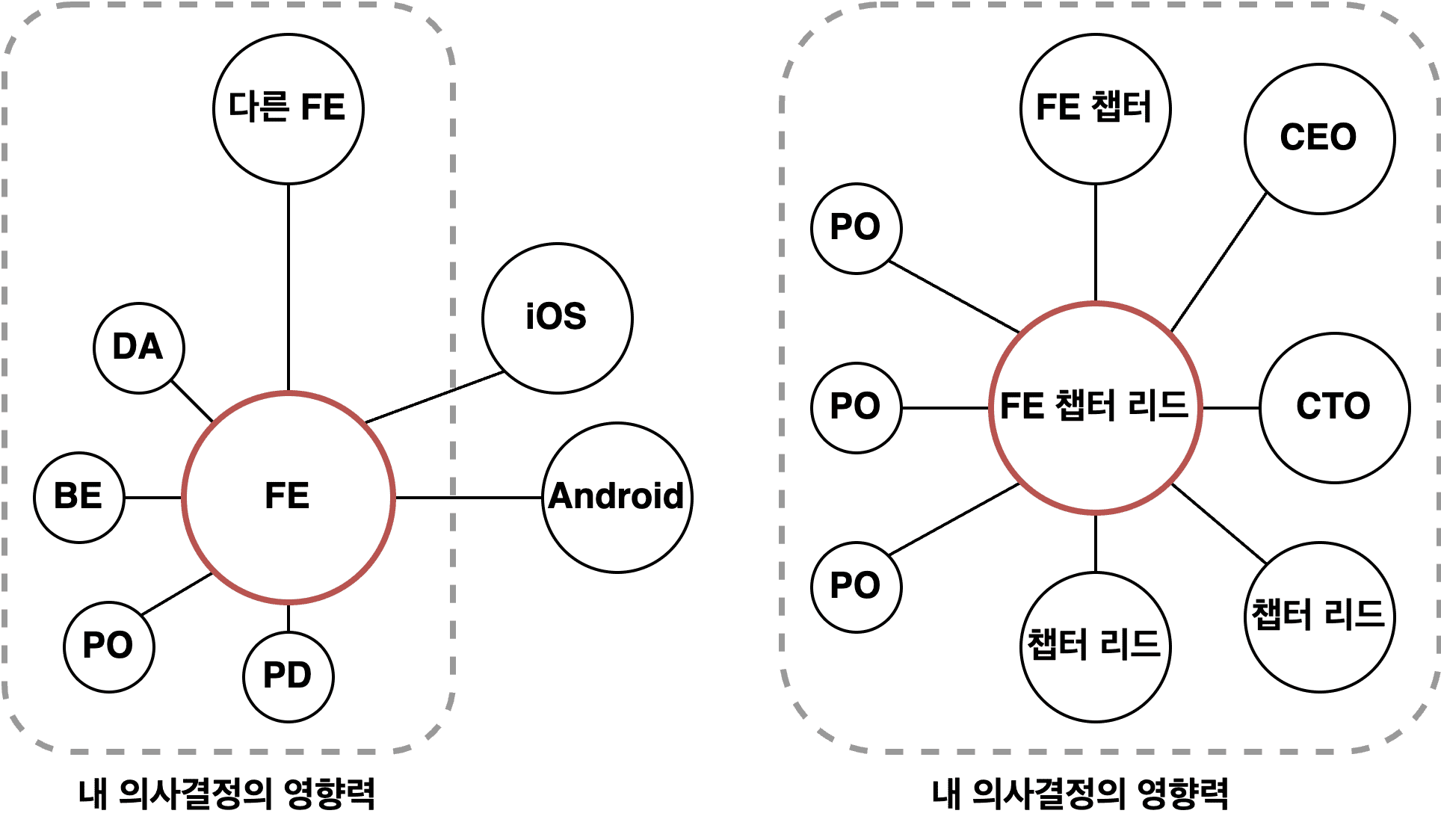 A leader's decisions affect and are evaluated by more people across the organization, commensurate with their expanded responsibility.
Considering this burden, being a leader isn't always as glamorous as it seems.
For this reason, I found myself exposed to evaluations from a much more diverse set of people than when I was an IC. It’s an environment where caring about those evaluations comes easily.
What’s interesting is how subjective these evaluations tend to be. When a leader proposes direction A, some people might say “I think they’re doing a good job” while others might say “I don’t think that approach will work.”
Of course, a leader is just another human, so their decisions are also driven by intuition shaped by personal views, values, experience, and available information. Even when quantitative data is available, data doesn’t speak for itself: interpreting it and making decisions still comes down to human intuition. A leader doesn’t always present the right answer; they present what they believe to be the right direction based on their own criteria.
Likewise, evaluations of a leader’s decisions are conducted through each evaluator’s own subjective criteria. Different people can view the same phenomenon and arrive at different assessments. If an evaluator tends toward conformity or introversion, they might even anchor their evaluation on the majority opinion or the views of someone they trust.
When the evaluation target is something quantitative — like OKR, NSM, or KPI achievement — you can make evaluations without much subjectivity. But when it comes to directions proposed before results are in, or missions that are hard to quantify like organizational culture, binary success/failure thinking doesn’t apply, and subjective factors inevitably become the basis of evaluation.
In summary: a leader’s values realistically may not earn everyone’s empathy. And evaluations of those decisions and values are often influenced more by perceptions of the leader as a person (likability and trust capital) than by the decisions themselves. This is especially true when the organization lacks shared foundational values.
 So sometimes in the course of work, you receive evaluations like this on anonymous platforms.
"TS" in the original referred to Toss, and I was the only developer in that organization who had come from Toss.
For example, imagine a leader with the value that “underperformers should be let go and high performers should be compensated accordingly.” Some might evaluate this as “Isn’t that obvious in a capitalist market economy?” while others might say “We spend most of our day at work, that feels too cold.”
Debating right and wrong on such values is largely pointless. There are no correct answers when it comes to ideology. Everyone simply advocates for the direction they believe in.
 This is easy to understand if you think about the parliament of a multi-party democracy.
Among the various ideologies different parties champion, which one is correct?
There is no correct answer. Each party simply argues for what they believe is right, for their own interests or the nation's.
But ultimately, the person in a leadership role must propose a specific direction they believe will create the greatest impact for the organization, based on their own values. Even in organizations that value diversity, without at least a foundational direction, you end up with chaos where everyone is just shouting what they individually believe is right.
So a leader must strike the right balance between direction and diversity: proposing a mission that team members can empathize with, then welcoming diverse opinions on how to achieve it, maximizing collective intelligence.
The direction I proposed was probably just one of many possible directions, and naturally, the many people within the organization each evaluated me according to their own subjective standards and values.
With more people evaluating me and their expectations and assessments diverging, it was an environment where caring about those evaluations came far more easily than before.
Positive evaluations and preconceptions from the blog
When I first started this blog in 2017, I was just an ordinary developer who enjoyed writing as a hobby. That hasn’t changed in 2023 — I’m still an ordinary developer. But having written for so long, people occasionally recognize me in daily life, talk to me about my posts, or even tell me they’re a fan.
Most people who know of my existence probably discovered me through my writing rather than through actually working or spending time with me.
People who first encounter me through the blog tend to think I’m a very serious, thoughtful person. This is probably because the written medium and my writing style don’t reveal much emotion, and my posts tend to cover academic topics or my personal philosophy.
That side is certainly part of me, but the person who exists in real life isn’t all seriousness. I’m actually closer to someone who just lives the way they want, rather than chasing the conventional values society prescribes: money, prestige, pedigree, credentials.

but I'm just an ordinary guy in his 30s who enjoys gaming with friends in the evening.
These positive evaluations and preconceptions have undeniably been helpful in my life. They’ve led to good career opportunities: job offers, side projects, and more.
But these evaluations don’t always bring only good things. In my case, the positive preconceptions actually caused me quite a bit of anguish.
Throughout my career as a developer, I have never once thought of myself as an outstanding developer. I am absolutely not a perfect human being. I have plenty of shortcomings and many experiences of failure when I encountered problems beyond my capabilities.
There are so many talented people around me that I still think of myself as just another average developer wandering around Gangnam or Pangyo.
But when I step away from the internet and meet people in real life, I occasionally hear things like:
“I want to become a developer like you.”
“Wow, it’s like meeting a celebrity.”
“Someone at your level doesn’t have to worry about making a living, right?”
“Can’t you just pick whichever company you want?”
The people who say these things are readers who love and resonate with my writing and who are cheering me on, and for that, I’m truly grateful. Having someone empathize with your thoughts and values and root for you is a genuinely happy thing.
But hearing these things, alongside gratitude, I also find myself thinking:
 Wait, I'm not quite at that level...?
In reality, I haven’t achieved financial freedom, I’m not a celebrity. I’m just an ordinary developer with lots of worries who happens to enjoy writing.
But as I’ve mentioned multiple times, evaluation is conducted according to the evaluator’s subjective criteria. People who first encounter me through the blog naturally lack detailed information about who I really am or what I’m actually capable of, so they evaluate me based on the surface-level information available to them, like blog posts or code on GitHub.
The problem from my perspective is that I have no way of knowing how inflated these evaluations are. Being human, when someone has expectations of me, I naturally want to live up to them and not disappoint. But if others’ evaluations are set far above my actual capabilities, satisfying them becomes difficult, and this psychology turns into pressure.
For a while, whenever someone recognized me or offered positive evaluations, I’d find myself straightening up, watching my words and behavior, becoming hyper-conscious of others’ perceptions in order to live up to their evaluations. (In plain terms, it was basically celebrity syndrome.)
Live as the master of your own life
Whether the evaluations are positive or negative, living a life focused on others’ judgments is stressful. Some people may derive fulfillment from others’ recognition, but fundamentally, other people’s hearts lie outside your sphere of control, and things don’t go the way you want more often than they do.
Moreover, focusing too much on others’ evaluations can shake your own values and cause you to lose direction. In my case, pouring too much energy into these evaluations led me to act against convictions I had long believed in, and the resulting stress manifested physically.
As you go through life and build your career, the number of people who remember you naturally grows through the work you’ve done. More people remembering you means more people who might evaluate you, and the more positive evaluations you receive, the easier it becomes to advance your interests within the vast organization that is society.
But that doesn’t mean you should outsource the fundamental evaluation of who you are entirely to others. As I said, others’ evaluations fundamentally lie outside your sphere of control.
I, too, found that the more I cared about these evaluations, the more I felt myself losing my center. I spent a long time thinking about how to break free. The first thing I did to reclaim that freedom was to classify what I can control and what I cannot, accept that distinction, and let go of my attachment to what I cannot control.
Clearly distinguish what you can and cannot control
If you look around carefully as you go through life, you’ll realize that the things you can truly control are fewer than you’d think. What you can control is mostly things where you are the subject: your thoughts, your emotions. Things involving other people beyond yourself are mostly in the uncontrollable domain.
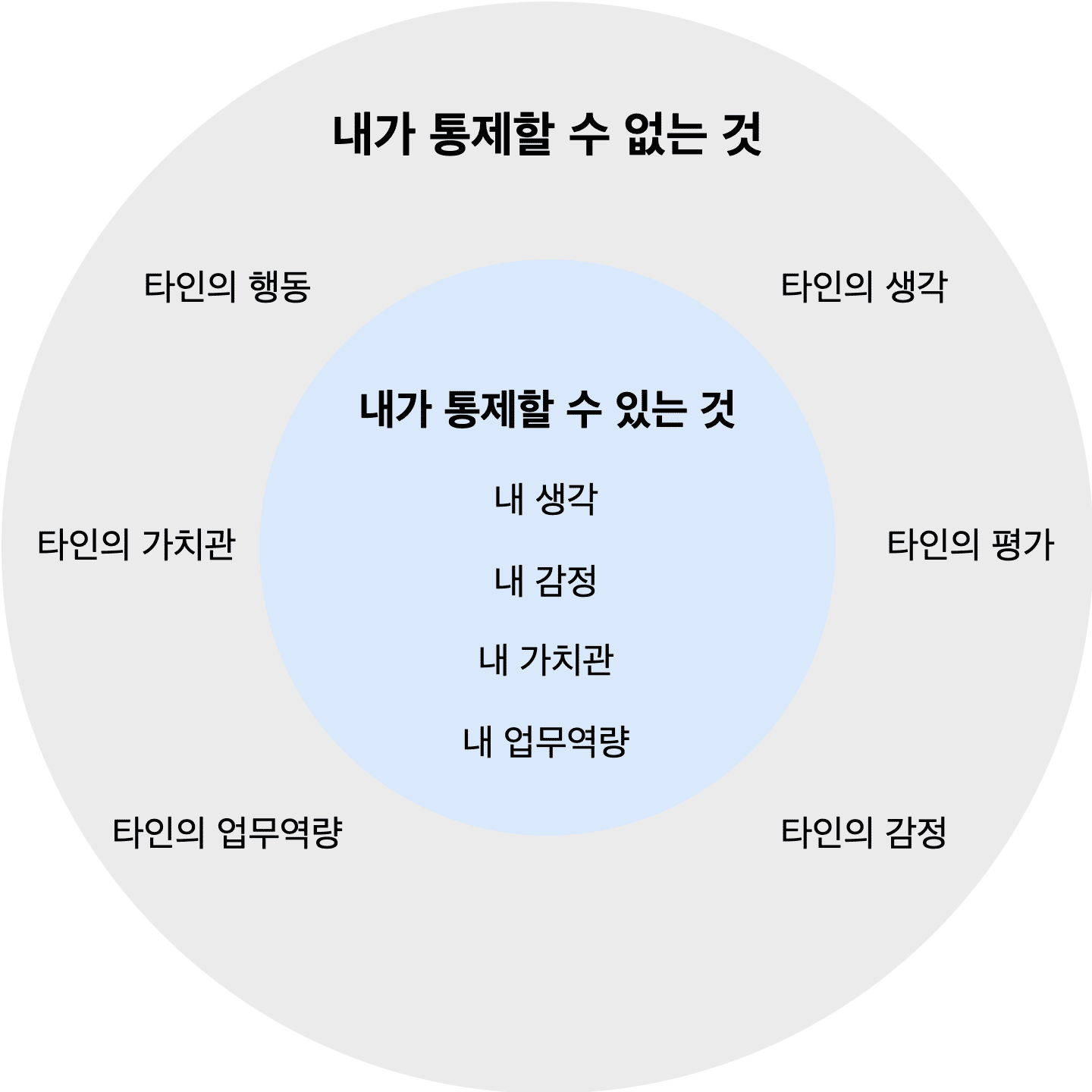
and where the uncontrollable domain begins.
In other words, how others evaluate me is a concept beyond my sphere of control. Of course, taking action to persuade or build empathy with someone in order to change their mind falls within my control, but the outcome of that action remains outside it.
At the outset, I said that people who want to be loved by everyone easily lose themselves. That’s because the desire to be loved by everyone tends to manifest as obsession with others’ evaluations — a concept that lies beyond one’s control.
The people around us hold a diverse range of values and ideologies, and this is true of any organization. Even when looking at the same phenomenon, different people can have different evaluations and emotional responses.
This reality is not something I can control. If I can’t control it, why obsess over it? No matter what I do, the people who will like me will like me, and those who won’t, won’t. Is there anything more self-destructive than desperately struggling to obtain something you can never have?
The “focus on impact” in life is about concentrating on doing better in the areas I can control, and about pulling things from the uncontrollable domain into the controllable domain wherever possible. Devoting excessive attention to things I currently cannot control is essentially spending a limited resource (focus) on something meaningless.
Recognizing and accepting these limitations connects to metacognition: being aware of what you know versus what you don’t, what you can do versus what you can’t. Awareness of your control boundaries is essentially recognizing the limits of the influence that “I” as a subject can exert on the world.
In the end, it is your mind that moves
One day, a banner was fluttering in the wind at a temple. Two monks began arguing about the sight. One monk said, “The banner is moving.” The other insisted, “The wind is moving.” The debate went back and forth with neither yielding.
Then Huineng, the Sixth Patriarch, spoke: “Neither the wind nor the banner is moving. It is your minds that are moving.” The two monks were stunned into silence.
The Gateless Gate, Case 29: Not the Wind, Not the Banner.
What was Huineng trying to say in this episode? The Gateless Gate is a collection of koans that pose questions without providing answers, so the book won’t tell you.
Reading this episode, my thought was: “Phenomena merely exist as they are; interpreting them is a subjective human judgment.”
The Avatamsaka Sutra, a scripture of Mahayana Buddhism, speaks of the core concept ilche yushimjo (一切唯心造), which literally means “all things are created solely by the mind.” I believe this is the key to living as the master of your own life.
Generally, the situations where people suffer from others’ evaluations involve negative rather than positive judgments. So imagine a scenario where someone is spreading gossip about you behind your back.
That gossip is almost certainly not 100% factual. Like most gossip, it’s probably a mixture of partial truth embellished with misunderstanding and subjective interpretation. Few people bother to verify the facts with the person involved — plain truth is far less entertaining than truth with added drama.
If you learned about this gossip, you might be swept up in emotions — frustration, feeling wronged, anger, betrayal. But where did these emotions originate? From the environment or situation where someone is spreading gossip about you? From the person doing the spreading?
No. Frustration, indignation, anger, betrayal: these emotions start within your own mind. These are your emotions, and as I discussed, your emotions lie squarely within your controllable domain. Regardless of what’s happening around you, it’s you who generates these emotions and makes yourself suffer.
This is the meaning of ilche yushimjo — all things are created solely by the mind. Of course, you may need to make value judgments about whether the situation itself is right or wrong, and if wrong, establish action items to address it. But you must not forget that devising a strategy to solve the problem and executing it are separate matters from your emotions.
 The water in the glass simply sits there — how you choose to see it is a matter of the mind.
Ilche yushimjo might sound detached from reality. But I think it may be the most necessary message for modern people suffering under the weight of constant evaluation and comparison.
Of course, learning that someone is spreading gossip about you or attacking you from behind anonymity is an emotionally difficult situation. But whether or not you’re suffering, unless you rationally analyze the root cause and take action to address it, the situation itself won’t improve.
In other words, what matters is improving the unhealthy organizational state that allows gossip to spread — not the fact that you became the subject of it.
So just approach it plainly: think about what caused the situation. If the cause is within your controllable domain, take swift action. If it’s not, focus only on whether you can pull it into the controllable domain.
If you understand ilche yushimjo and can keep your emotions squarely within the controllable domain, you gain the ability to observe the phenomena around you with a more rational eye, focused on the essence of the problem.
This isn’t about eliminating emotions. It’s about not letting your emotions depend on external variables like surrounding situations or environment. Regardless of your circumstances, your emotions are yours to control. You can be happy or unhappy regardless of what’s happening around you.
Remember that most evaluations are two-sided
When you habitually pay attention to evaluations around you, it’s easy to focus more on negative evaluations than positive ones. Humans are wired to react sensitively to threats from negative information, a kind of negativity bias. (They say newspapers and news programs sell negative stories better than positive ones, too.)
If you’re not yet skilled at emotional control, this can spiral into self-deprecating thoughts like “I’ll never make it” and drag you into a pit of despair. Once you fall into a cycle of giving yourself negative feedback, climbing out on your own isn’t easy.
But in reality, evaluations of any specific person are mostly two-sided. That is, most people don’t evaluate you as purely bad or purely good — they see both strengths and shortcomings.
This is only natural, when you think about it. Every human has both strengths and weaknesses, so you’re likely to receive positive evaluations on your strengths and critical ones on your weaknesses.
Of course, biases like actor-observer bias or self-serving bias can lead people to judge others more harshly than themselves. But fundamentally, any rational adult will make a somewhat balanced evaluation of a specific person. (If someone only has negative things to say about a particular person, they likely lack the ability to view phenomena from multiple perspectives — I’d recommend keeping your distance.)
Internalizing the fact that most evaluations are two-sided and balanced does a great deal to protect your self-esteem. Of course, focusing only on positive information can blind you to reality, so striking the right balance is important. And this isn’t just a hypothetical — it’s the reality playing out around you right now.
What matters is maintaining your own balanced perspective: reinforce what others evaluate positively about you, and improve what they evaluate negatively. There’s no need to let your mood worsen or improve because of these evaluations. As I’ve been saying, simply acknowledge the plain fact that an evaluation occurred, and take action items to reinforce or improve accordingly.
Closing thoughts
Like everyone else, I’ve faced countless evaluations throughout my life. This was true not just as a developer, but also during my younger days as a b-boy and sound engineer.
No matter how little someone values relationships, we all inevitably interact with other humans within the vast network of society. And in that process, it’s only natural that others will form evaluations of us.
But if you become too consumed by these evaluations, you risk losing your true self. Others’ evaluations and advice may sometimes warrant adjustments to your values or life direction, but the decision-making authority must belong solely to you. You must never delegate that authority to others.
The words and evaluations we direct at others cost us nothing. Others can evaluate you, but they almost never bear responsibility for those evaluations.
In other words, they’re not deliberating over their judgments with the same gravity as, say, deciding whether to buy a billion-won apartment.
So I’d recommend not giving those evaluations too much weight. Ultimately, my value is determined by my own reason, and I believe any mature adult with sound values should do the same.
As I’ve discussed, there are no correct answers when it comes to human thought and values. These ideas simply exist, and everyone’s judgment of them can differ.
“Is working at a startup the right choice? Or a large corporation?”
“Is trading work-life balance for high income the right choice? Or is protecting your time over money?”
“Is equality of opportunity right? Or equality of outcome?”
No one can provide correct answers to these ideological questions. You simply choose according to the values you believe in.
So stop trying to find the right answer or trying to be loved by everyone. Follow the convictions you believe in, walk the path you think is right, and maintain your own pace.
Comparing yourself to others, getting emotionally invested in situations that won’t matter in hindsight, struggling for things you can’t have right now: the one making yourself suffer through all of this is yourself.
If you take full control of yourself and observe the phenomena around you rationally, you might realize that you’ve been overcomplicating what are, in truth, rather simple problems.
This concludes my post: Can I Ever Be Free from Others’ Judgment?