Is Work Hours Really All There Is to Work-Life Balance?
Why do we see work only as an obstacle to life?

Work-Life Balance literally means the balance between work and your personal life. This term is so famous that I don’t think I need to explain what it means. The concept actually starts from a negative view of work.
While work-life balance only started trending in Korea recently, making it seem like a modern buzzword, the term “Work-Life Balance” actually appeared in the UK in the late 1970s — it’s already about 50 years old. I think this unfortunate term emerged from a combination of corporate culture that squeezes employees for performance and the struggles of workers who have to do jobs they don’t particularly want to do, solely for money.
Korea’s Current Work-Life Balance Situation
Looking at the flood of news articles, you often see Korea getting criticized as an OECD country with extremely long working hours but low productivity. But since I don’t fully trust these articles, I decided to look up the statistics myself on the OECD website.
First, I searched for Hours Worked statistics — the average annual working hours for 2018 on the OECD data site. Maybe the articles were based on incorrect statistics?
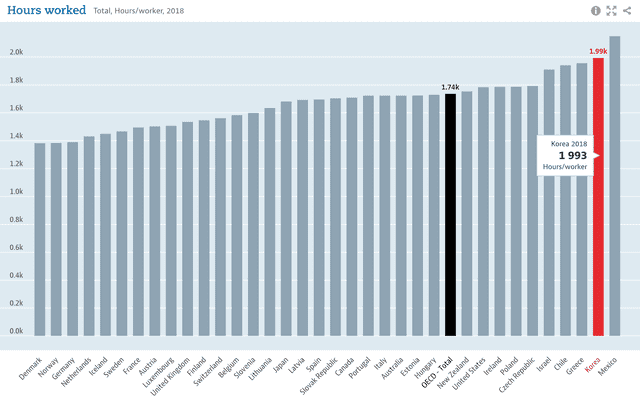 Average annual working hours in OECD countries
[Source] https://data.oecd.org/emp/hours-worked.htm
…we’re undeniably top tier.
Sadly, the statistics show Korea is indeed top tier among OECD member countries for working hours. As we all know, a day is limited to 24 hours, so the longer working hours get, the less time we naturally have for ourselves each day. This is why people say work-life balance collapses and quality of life deteriorates.
We’ve all experienced overtime, so even without examining OECD statistics, we all know and feel that Korea’s working hours are on the long side.
So what if the government heavily regulates workers’ hours and cuts them down, like the recent 52-hour workweek law? But if you think about it, this approach isn’t that simple to implement. Because of Korea’s productivity.
Looking at OECD statistics, while Korea’s productivity has been improving since 2010, GDP per working hour isn’t particularly outstanding, making it difficult to easily reduce working hours.
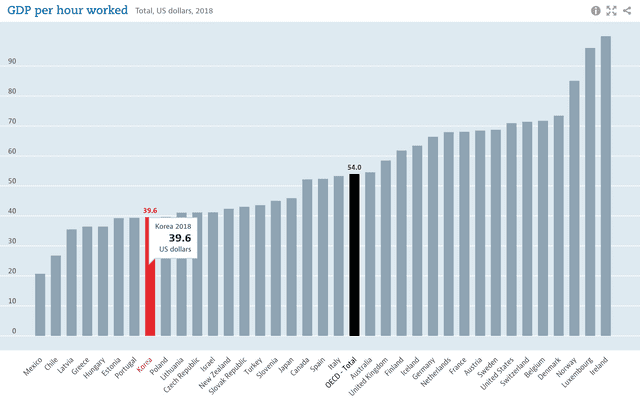 GDP per hour worked in OECD countries
[Source] https://data.oecd.org/lprdty/gdp-per-hour-worked.htm#indicator-chart
Of course, GDP isn’t only influenced by working hours — it’s affected by various factors like each country’s industrial structure and foreign companies entering the domestic market. But looking at the graph, Korea’s GDP per working hour is lower than countries like Poland and Slovakia, which have smaller economies and shorter working hours, so it’s hard to say our productivity is good.
GDP doesn’t directly impact our daily lives, so it might not feel relevant. But ultimately, declining GDP means Korea’s economic scale is shrinking, which will eventually boomerang back to us as salary freezes or job shortages.
The 52-hour workweek wasn’t implemented just because citizens were suffering too much. It was implemented because Korea’s productivity per working hour improved compared to before, creating a situation where limiting working hours to 52 per week could protect both citizens’ work-life balance and domestic production. (I doubt any country would guarantee work-life balance while sacrificing the national economy)
Companies are the same as the government. I don’t think many companies are prepared to protect employees’ work-life balance at a loss. Companies that maintain good work-life balance do so because they believe it makes employees more productive.
Let me summarize Korea’s current work-life balance situation: unless Korea’s work efficiency improves dramatically, the government will find it difficult to make citizens work less than 52 hours per week.
 Either way, we have to grind at the office for about 8-10 hours a day
Unless we become building owners, we’ll always have to work until retirement. And work-life balance views this work negatively, as a minus element in personal life.
More specifically, work-life balance means combining work (-) and personal time (+) to make quality of life at least approach 0. And as time for myself to recharge increases, my quality of life tilts toward the plus (+) side, so it also contains the value that the less you work, the higher your quality of life.
But is there a reason why work time must lower my quality of life and only consume energy? Can’t work time also raise my quality of life and give me value?
Does Work Really Lower My Quality of Life?
When we go to the office, we want to leave quickly. So we can drink with friends after work or watch a movie at home with a beer. But why exactly do we feel that time after work is better than time working at the office?
Honestly, the answer is simple.
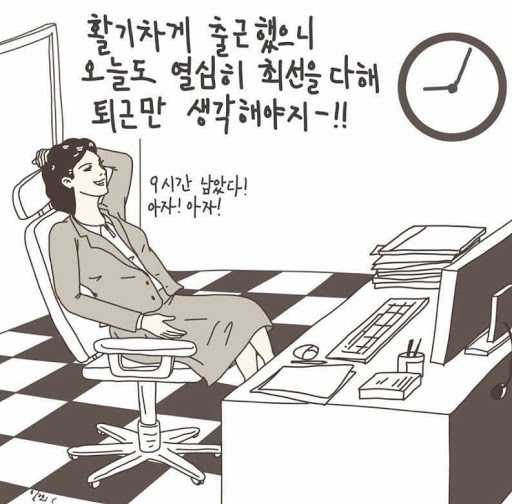 Because work f***ing sucks. Because I just want to play and eat.
Honestly, everything we do at the office is a series of intensity and stress. Every task has a deadline, we have to be with colleagues and bosses who can evaluate us, and it’s not easy to bare our hearts to coworkers. We can endure all this only because of the reward we get for putting up with it all: “money.”
Thinking back, everything we did in school was ultimately to get a good job and earn money stably. Getting into a good university, studying for certifications, even volunteering — wasn’t it all to stand out a bit more in the job market later, get better scores, and land a better job?
Having lived this way, we naturally endure difficult and hard things at work because of money. If I quit this job, I lose fixed income, making it burdensome to pay fixed expenses like phone bills and jeonse loan interest. Then I have to tighten my belt and give up many things I’ve been enjoying because I need to save money.
We can endure because the value of our salary is bigger and heavier than enduring unpleasant work at the office. When people judge that their salary’s value has become lighter than working at the office, they often renegotiate salary or change jobs.
Looking at these situations, it seems natural that work is a minus element in our lives. But is it really?
Do we work only for money? Is there no other meaning?
Why Do We Work?
American psychologist Barry Schwartz gave a TED talk in 2014 titled “Why We Work,” and I personally found this talk very interesting.
Barry Schwartz starts by asking, “Why do we work?” Of course, we know the obvious fact that we work to earn money, but his question is whether that’s really the only reason we work.
Adam Smith, the father of modern economics, said in his book The Wealth of Nations that humans are animals who instinctively choose to maximize their own benefit in any situation. Because of this instinctive human selfishness, division of labor occurs in the market, and when everyone moves to maximize their own benefit, the market develops and national wealth accumulates.
Adam Smith believed that humans, being selfish animals, won’t work without appropriate compensation for their labor, and if you want people to work more and efficiently, you need to give them appropriate value. This Adam Smith value system is fully embedded in our current mindset of “I have no choice but to go to work because of money.”
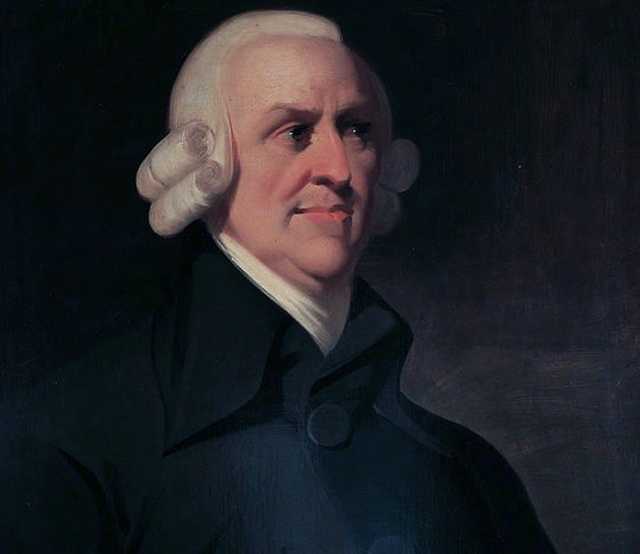 "Humans are selfish, so they won't do anything without rewards"
Adam Smith’s view is somewhat valid. For example, the lady making kimbap at Kimbap Heaven is more likely running a kimbap shop to earn money, not rolling kimbap with a humanitarian heart hoping “people won’t go hungry because I make kimbap…”
But Barry Schwartz’s view differs. Barry Schwartz says human nature isn’t something fixed that gets discovered — it’s created by regulations and systems. He argues that various systems created during the industrial era based on Adam Smith’s mistaken views still make us work while only looking at money.
 "You're wrong, man. People actually believe it because you put out weird values"
Of course, both Barry Schwartz and Adam Smith have right and wrong parts, so we can’t accept everything uncritically. But it’s worth thinking about why Barry Schwartz says this.
What Makes Humans Work
As mentioned, Adam Smith’s view that “humans want appropriate rewards for labor” still influences us living in modern society. One representative example is the incentive system.
The incentive system emerged from thinking that humans selfishly labor for their own rewards, so if you promise bigger rewards for doing more work, they’ll definitely do it. This system still remains with us, filling our bank accounts nicely. (Money solves everything…?)
But we can’t just blindly trust our ancestor’s words. Scholars worldwide conducted experiments on whether incentives actually help improve human work efficiency. The results were quite interesting.
For simple repetitive tasks, incentives worked effectively. But conversely, for complex tasks requiring creativity, incentives worked in the opposite direction.
This isn’t something I picked up somewhere — it’s been tested quite extensively by reputable institutions like the Federal Reserve, Princeton University, London School of Economics, and various economists. In almost all results, incentives hindered productivity in creative tasks.
Factors that positively influenced creative work were autonomy and control over work, enjoyment of work, and the desire to improve.
The difference between incentives and these factors is external versus internal motivation. Incentives are external motivation saying “if you do this work well, I’ll give you this much reward,” so the person doing the work has to do it for money whether they like it or not, trying to quickly achieve only the goal that gets them rewards, narrowing their perspective on the task. But people who know the value of this work, enjoy it, and want to do it well can freely set broader goals instead of narrow ones, raising creativity in their work.
This is why Google and Atlassian allocate about 20% of the day to side projects. This is time where workers have complete control to do what they want, and many products we use today were born during this time.
This incentive content often appears in corporate consulting, usually targeting owners, but it suggests important points for employees like me too.
Looking only at money makes it hard to work well. You have to enjoy the work itself.
Of course, most Korean companies don’t provide autonomous work environments to employees, and rather than presenting cool visions to employees, they’re desperate to fill daily sales, so finding enjoyment in work in such environments might seem difficult.
I also empathize because I’ve experienced developing while only looking at company sales or my salary in non-autonomous work environments. But I think there are definitely visions you can present to yourself even in such unfavorable environments.
Or changing jobs is a solution. Of course, changing jobs isn’t easy and there’s natural anxiety about leaving a familiar environment, but I think the value of being able to work in an organization where I can work happily is much greater than two to three months of anxiety during the job search. So if my current workplace can’t make me happy, I think you need to cut it off.
And these things are necessary for our own happiness — we have to work every day for about 30 years until retirement, not for the company. I don’t think anyone wants to become a person who works like a machine for money. If we have to work anyway, isn’t it better to work more enjoyably and happily?
Barry Schwartz said the seemingly unchangeable reality of “working for money” is ultimately a frame created by the system, and we can break it depending on how we approach work. Ultimately, depending on how we think, work that’s done only for money can transform into something that makes our hearts race.
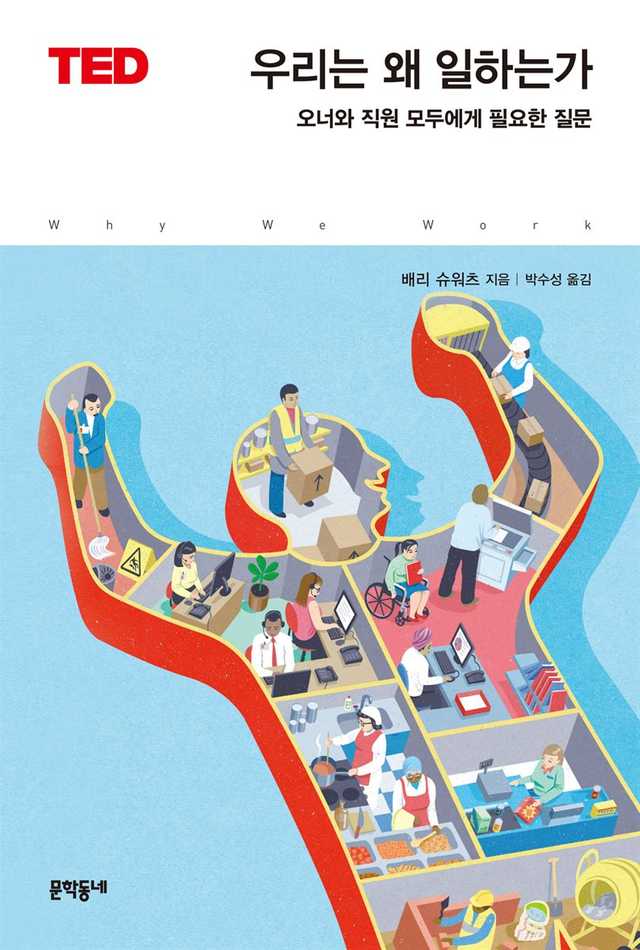
so I recommend reading the book rather than just watching the TED talk
So What About My Work-Life Balance?
It would feel incomplete to end here, so let me talk in detail about my own values regarding work-life balance.
First, to be honest: I’m not Buddha, detached from the world and transcending all desires. Of course I love money too. Money is obviously better the more you have. I was one of the retail investors who poured cold water and prayed during Apple and Tesla’s stock splits. (Mom asked how many Tesla shares I have during Chuseok…)
 Ancestors... please make Tesla hit $600...
But even though I love money, salary isn’t my #1 reason for choosing a workplace. You might think “well, he earns a lot so he can say that,” but I don’t earn that much either. Of course I earn more than some and less than others, but honestly, a difference of a few thousand won in annual salary isn’t enough to change someone’s life, is it? (Don’t forget that ultimately the bank buys your house)
Like most developers, I became a developer because I enjoy creating things through programming. So naturally, I focus on “what products can I make at this company?”
Because my work-life balance heavily depends on this.
No matter which company I join, I’ll spend most of my day in the office coding. Spending my day making boring products I don’t care about is a horrifying thought. Even if they pay me a lot, spending 10 hours a day like penance on boring time doesn’t seem to help my quality of life much.
Of course, if they paid me 200 million won salary, I could endure it, but that’s literally just enduring, so the stress I receive at the office would remain. I hate spending most of my day under such stress more than earning a lot of money.
My reason for choosing my current workplace also aligns with this value. This company had an interesting vision of “making difficult finance easier and more convenient,” and during interviews, I felt this was an organization really working hard to make this vision reality. After joining, I found the organization internally puts a lot of effort into keeping team members focused on this direction.
Of course, this company is famous for high work intensity, and it’s actually not that easy. But at least I can make products while being properly convinced of what benefits these products can give people, and there are many good people, making work more fun compared to other workplaces.
You, like me, will probably spend most of your day working at the office. If work-life balance meant only reducing work hours to improve quality of life, my work-life balance would be a total mess. But from my own perspective, my work-life balance level is pretty decent.
Closing Thoughts
Of course, work time and personal time for yourself should be separated, and the balance and harmony of these times matter. Obviously, people can’t live working all the time, so spending precious time with family, friends, or lovers during non-work hours, pursuing dreams unrelated to work, or having hobbies are also desirable directions for improving quality of life.
But realistically, we can’t live without working for the various reasons mentioned. In this situation, if we think of work-life balance only as reducing work time, our quality of life has a clear upper limit, so we need to find something that can give us higher value than simply reducing work hours.
Of course, my values about work-life balance are very personal opinions. People assign different values to actions, so unlike me, some people might not want to place much value on work. These people will look for something that can give them more happiness in non-work time rather than finding value in work like me.
But what I want to say through this post is that we don’t have to think of work as something we’re forced to do for money. Whether it’s actually done for money or not.
As Barry Schwartz said, whether we work for money or can find value beyond that ultimately depends on how we think about and approach work.
And I think giving meaningful value to the act of work, which takes up most of our day, lets us spend at least slightly better time than spending most of the day working dully.
That concludes this post about maintaining both work and work-life balance.